From Daniel Mitsui we have this extraordinary crucifixion.
I like that a lot. I do wish that he hadn't labelled everyone, though. Much better to let the symbolism speak for itself. (But that's a minor quibble.)
It's funny that I should stumble across this particular depiction because I visited an exhibition about the history of the Swiss Guards in the Vatican last week and noticed some old flags presented to the various Swiss Cantons some centuries ago. (I meant to take note of exactly when...) Anyway, some of them had depictions of the crucifixion as part of their design, and included in these depictions were Christ's linen garment with three dice on top. It's something that one occasionally sees included in depictions of the crucifixion. I'm actually a little curious about the specific history and significance of this inclusion which is most uncommon.
Saturday, May 13, 2006


In the papers...
From the Telegraph, this story about tackling crime in Naples:
Tourists checking into hotels in Naples this summer are to receive an unusual gift as part of an innovative scheme to protect visitors from gangs of "Rolex-snatchers".There's a story about the spread of a certain brand of Protestantism in the Ukraine (some readers may find the content offensive):
Every guest will find a cheap plastic watch by their beds emblazoned with a motif of either a pizza or Mount Vesuvius.
Attached to the watch will be a piece of paper saying: "Leave your Rolex in the hotel safe, and keep track of your holiday time with this simple sign of welcome."
It is hoped that the tackiness of the watch, the centrepiece of a £150,000 programme dubbed "Operation Bluff the Bandits", will deter the crime-ridden city's myriad bag snatchers and pickpockets.
The Orthodox Church in Ukraine is not quite sure which part of Sunday Adelaja's weekly services it likes the least.
The dubious Russian pop and the pom-pom-waving Cossack dancers are certainly contenders. The hot babes in choir dress swaying to the music might win the vote of its many older and weaker-hearted clergymen.
Or it could be the thousands of Ukrainian teenagers squealing as the diminutive Nigerian pastor preaches the word of God.
In the 1,000 years that it has been in existence, the Ukrainian Orthodox Church has faced down many threats ranging from Reformation-era heretics to Soviet iconoclasts and modern day schismatics.
But never before has it had to see off an intruder who encourages his congregants to "shake their booty and praise the Lord". Mr Adelaja is a serious threat, even if it took the Church a while to realise it.
Friday, May 12, 2006
Ruth Kelly tries to serve God and Tony
Many thanks to the correspondant who sent me this piece from the Telegraph on the travails of British politician and member of Opus Dei Ruth Kelly. Read the whole thing...
Thursday, May 11, 2006
Inquietum est cor nostrum...
From the Confessions of St Augustine, Chap 1 of Book 1:
Folks, I'm afraid that I have been quite busy of late, but I thought I'd share one of the things that has been bouncing around my little head for the past few weeks.
It's about the start of St Augustine's Confessions. It seems to me that people have jumped on the famous line our hearts are restless till they find rest in Thee without fully considering the context. Certainly, the restlessness of our hearts and the insatiability of our will does in some sense point to the fact that our destiny is not confined to this passing world, but I sometimes think that we make the mental leap from this restlessness to our supernatural destiny. One of the difficulties that the believer needs to face is that the mysteries of Christianity become commonplace, and we fail to grasp how extraordinary the life of the believer is. This intuition of Augustine is a hard-won and subtle insight that grounds the potential of our communion with the Divine and the possibility of our Redemption.
Furthermore, I am not sure that we are not doing Augustine an injustice by reading that line in isolation. Firstly, I think it can lead us to take our supernatural destiny as less than gratuitious. Secondly, I think that we run the danger of confusing our natural (and insatiable) will with a genuine love and desire for the Divine. I think that it is significant that Augustine seems to suggest that it's not simply some kind of natural desire within him that is crying out to God, but rather he says: my faith calls on Thee, --that faith which Thou hast imparted to me, which Thou hast breathed into me through the incarnation of Thy Son, through the ministry of Thy preacher.' Augustine himself is wrestling with the problem of knowing God and the relationship between Creator and creature, but I suspect that we neglect the role of explicit (supernatural) faith in this reflection at our peril.
GREAT art Thou, O Lord, and greatly to be praised; great is Thy power, and of Thy wisdom there is no end. And man, being a part of Thy creation, desires to praise Thee, man, who bears about with him his mortality, the witness of his sin, even the witness that Thou "resistest the proud, " -- yet man, this part of Thy creation, desires to praise Thee. Thou movest us to delight in praising Thee; for Thou hast formed us for Thyself, and our hearts are restless till they find rest in Thee. Lord, teach me to know and understand which of these should be first, to call on Thee, or to praise Thee; and likewise to know Thee, or to call upon Thee. But who is there that calls upon Thee without knowing Thee? For he that knows Thee not may call upon Thee as other than Thou art. Or perhaps we call on Thee that we may know Thee. "But how shall they call on Him in whom they have not believed? or how shall they believe without a preacher?" And those who seek the Lord shall praise Him. For those who seek shall find Him, and those who find Him shall praise Him. Let me seek Thee, Lord, in calling on Thee, and call on Thee in believing in Thee; for Thou hast been preached unto us. O Lord, my faith calls on Thee, --that faith which Thou hast imparted to me, which Thou hast breathed into me through the incarnation of Thy Son, through the ministry of Thy preacher.'
Folks, I'm afraid that I have been quite busy of late, but I thought I'd share one of the things that has been bouncing around my little head for the past few weeks.
It's about the start of St Augustine's Confessions. It seems to me that people have jumped on the famous line our hearts are restless till they find rest in Thee without fully considering the context. Certainly, the restlessness of our hearts and the insatiability of our will does in some sense point to the fact that our destiny is not confined to this passing world, but I sometimes think that we make the mental leap from this restlessness to our supernatural destiny. One of the difficulties that the believer needs to face is that the mysteries of Christianity become commonplace, and we fail to grasp how extraordinary the life of the believer is. This intuition of Augustine is a hard-won and subtle insight that grounds the potential of our communion with the Divine and the possibility of our Redemption.
Furthermore, I am not sure that we are not doing Augustine an injustice by reading that line in isolation. Firstly, I think it can lead us to take our supernatural destiny as less than gratuitious. Secondly, I think that we run the danger of confusing our natural (and insatiable) will with a genuine love and desire for the Divine. I think that it is significant that Augustine seems to suggest that it's not simply some kind of natural desire within him that is crying out to God, but rather he says: my faith calls on Thee, --that faith which Thou hast imparted to me, which Thou hast breathed into me through the incarnation of Thy Son, through the ministry of Thy preacher.' Augustine himself is wrestling with the problem of knowing God and the relationship between Creator and creature, but I suspect that we neglect the role of explicit (supernatural) faith in this reflection at our peril.
Monday, May 08, 2006
On things liturgical...
I note the following aside at Shouts in the Piazza about the feast of Corpus Christi:
And from the Telegraph:
The Pope still celebrates it on the Thursday after Trinity Sunday while everyone else (including the rest of the diocese of Rome) celebrates it on the Sunday after Trinity Sunday. So...which one?The explaination is simple - the Italian Episcopal Conference have moved the celebration to Sunday. However, the change doesn't apply to the Vatican City. That's why the Pope still celebrates on Thursday, even though the Papal Corpus Christi procession is on Italian soil.
And from the Telegraph:
Home owners worried about crime in their street, the problem of rising damp or lacklustre sex in the bedroom can now call on divine assistance.*cringe*
The Church of England is going into partnership with estate agents to offer blessing services to people moving home.
From this week, house buyers in a number of dioceses will be offered the services of a vicar, who will say special prayers to cover almost every eventuality.
Clergy behind the scheme want to tap into the explosion of interest in New Age practices such as feng shui as a way of tempting people back to church.
The Rev Chris Painter, a vicar in Eccles, Greater Manchester, has helped to pioneer the initiative. He is confident that it will show that Christianity can adapt to an increasingly secular age.
"There is still a huge interest in spirituality and this is a way of our meeting that, but not in a traditional way," he said.
"The current trend in New Age spirituality is aimed at self-fulfilment, people wanting to be happy and achieve things. We are trying to focus on Christianity and show people that God has an interest in our lives."
Many Christians will be familiar with blessing services. In the case of non-churchgoers, clergy will spend time with them to ensure that they are happy about the process before the blessing is given.
As the vicars go from room to room, they will lay hands on everything from the bed, praying for a healthy sex life, to the lavatory, asking for "good health and to give thanks for sanitation".
Pope to meet fewer politicians...
From the Telegraph:
The Vatican has sharply cut back the number of political audiences to prevent the Pope being exploited by visiting politicians looking for headlines.This seems to match what I'm seeing on the ground - without a doubt, Benedict is not granting as many audiences as Pope John Paul did.
From now on, only heads of government and heads of state will be granted an audience with the pontiff.
A set of tough new rules has been drafted to protect 79-year-old Pope Benedict XVI from the flood of requests that arrive daily.
(snip)
The Vatican outlined the rules in a letter to papal nuncios, its ambassadors abroad. One month's notice is needed and meetings will be restricted to Friday and Saturday mornings.
If there are several heads of state in Rome for a summit, they will meet the Pope at the same time.
Sunday, May 07, 2006
Heh!
I'm listening to the 2006 Reith Lectures on the BBC at the moment. Orchestra conductor Daniel Barenboim is lecturing about the relationship between music and society. Anyway, I had to share the following snippet from the 2nd lecture:
And the most extraordinary example of offensive usage of music, because it underlines some kind of association which I fail to recognise, was shown to me one day when watching the television in Chicago and seeing a commercial of a company called American Standard. And it showed a plumber running very very fast in great agitation, opening the door to a toilet and showing why this company actually cleans the toilet better than other companies. And you know what music was played to that?
(FEW BARS OF A RECORDING PLAYED)
The Lachrymose [sic] from Mozart's Requiem. Now ladies and gentlemen, I'm sorry, I'm probably immodest enough to think I have a sense of humour but I can't laugh at this. And I laugh even less when I read some, a document which I've brought here to read to you in its entirety. It was published, I'm afraid I don't know in what newspaper, but it is the Editor's note. The following is a letter sent in by Christine Statmuller of Basking Ridge, it is in reference to her previous letter which ran in the April issue of The Catholic Spirit. 'Thanks for printing my letter in which I objected to the use of music from Mozart's Requiem by American Standard to advertise their new champion toilet. As you can see from the enclosed letter below, it achieved results, thanks to the letters from other incensed readers.' And the letter is as follows:- 'Thank you for contacting American Standard with your concerns about the background music in the current television commercial for our champion toilet. We appreciate that you have taken the time to communicate with us, and share your feelings on a matter that clearly is very important to you.'
(LAUGHTER)
'When we first selected Mozart's Requiem, we didn't know of its religious significance.'
(LAUGHTER)
'We actually learned about it from a small number of customers like you, who also contacted us. Although there is ample precedent for commercial use of spiritually theme music, we have decided to change to a passage from Wagner's Tannhauser Overture,'
(LAUGHTER)
'which music experts have assured us does not have religious importance.'
(LAUGHTER)
'The new music will begin airing in June.'
(LAUGHTER)
I think that says it all!
Meme...
From The Cafeteria is Closed:
Let's try the second nearest book...
And when I asked him how he could tell this from the molten lead, he answered, 'There are seven metals belonging to the seven planets; and since Saturn is the Lord of lead, when lead is poured over anyone who has been bewitched, it is his property to discover the witchcraft by his power.' From Malleus Maleficarum (The Hammer of Witchcraft) by Jacobus Sprenger and Heinrich Kramer.
1. Grab the nearest book.Hmpf! The nearest book (the Penguin Edition of Truman Capote's Breakfast at Tiffany's) has only 160 pages.
2. Open it to page 161.
3. Find the fifth sentence.
4. Post the text of the sentence along with these instructions.
5. Don’t search around and look for the coolest book you can find. Do what’s actually next to you.
Let's try the second nearest book...
And when I asked him how he could tell this from the molten lead, he answered, 'There are seven metals belonging to the seven planets; and since Saturn is the Lord of lead, when lead is poured over anyone who has been bewitched, it is his property to discover the witchcraft by his power.' From Malleus Maleficarum (The Hammer of Witchcraft) by Jacobus Sprenger and Heinrich Kramer.
In S.Maria in Trastevere...

I found myself in S.Maria in Trastevere today, and thought this fresco of the Council of Trent was worth snapping. I'm guessing that's 'Heresy' being squished at the bottom right.
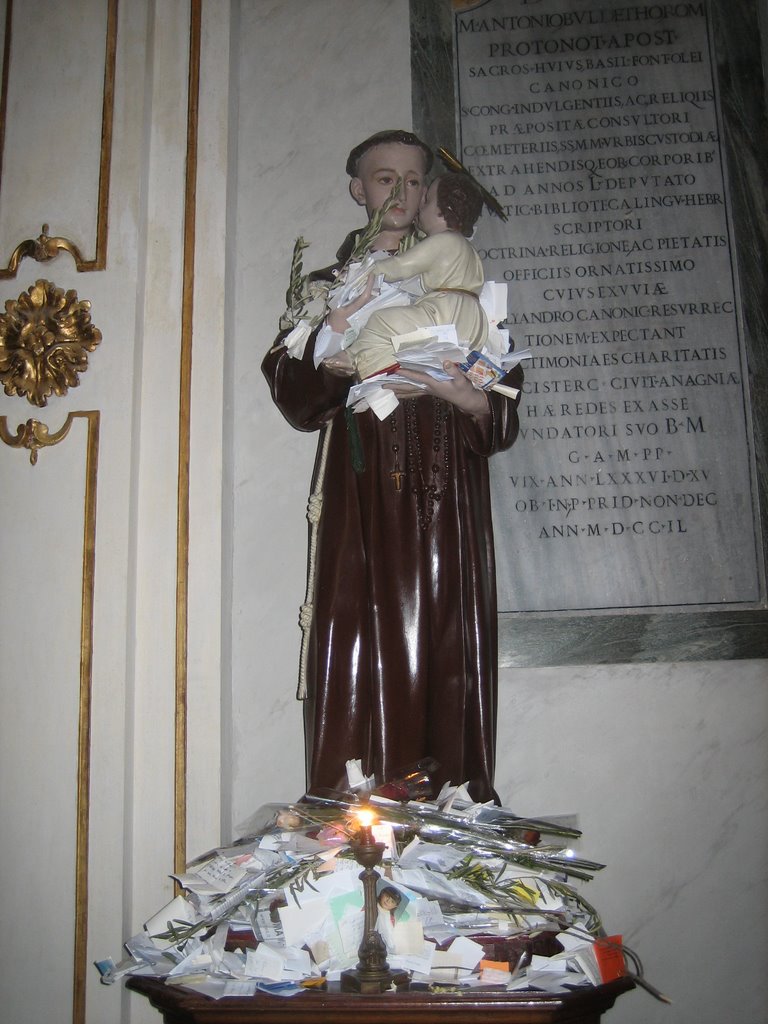
And I was taken by the statue of St Anthony. Look at all the petitions. If your church has a stautue of St Anthony, I can guarantee that it's one of the big money-makers for your parish.
Saturday, May 06, 2006
Fascinating (Brideshead Revisited Companion)
I stumbled across this fascinating website whilst trying to find out about the Savoy Chapel where the divorced Rex was able to marry Julia. I had assumed previously (and incorrectly) that it might have something to do with the Savoy Hotel, but I discover that it is a 'Royal Peculiar':
178 Savoy ChapelI'm also pleased to find an explaination for cousin Jaspar's comment about Boar's Hill:
Julia later explains to Charles how sordid the whole affair had been. She points out that the Savoy Chapel was ‘the place where divorced couples got married in those days - a poky little place’.
The Chapel in fact has an interesting history. Savoy is today a province of France but in the Middle Ages was a more-or-less independent dukedom. King Henry III of England married Anne of Savoy and so began the Anglo-Saxon involvement with the word Savoy. Her uncle Peter of Savoy built a palace in London which contained the original Savoy Chapel; both were destroyed in the Peasants’ Revolt (1381). On its site Henry VII started to build the Savoy Hospital for homeless people in the last years of the fifteenth century; it was not completed until 1512. It was huge, with a nave 200 feet long designed to hold a hundred beds. All that now remains of that great endeavour (dissolved in the Reformation) is the side chapel we call the Savoy Chapel, though the hotel and the theatre which were later built on the site were also named Savoy.
The Chapel is in fact in the private possession of the monarch, and has been since 1937 the official chapel of the Royal Victorian Order. The fact that the chaplain is answerable only to the monarch and not to the church authorities allowed divorced people to book it for remarriage.
26 Keep clear of Boar’s Hill
Boar’s Hill was a village to the south-west of Oxford. Many dons lived there. It was supposed to contain many young females who were always on the lookout to entrap eligible young undergraduates into devotion, engagement and marriage. But a more likely explanation of Jasper’s aversion is that a number of ladies (e.g. Lady Keeble) maintained literary salons in Boar’s Hill which encouraged a stifling rather than liberating air of intellectual seriousness. These might on the other hand be sufficiently attractive to inveigle students away from their books to the delights of intelligent social discourse.
There is a splendid and famous view of Oxford from Boar’s Hill.
In the news...
The Times has an article about the possible election of any one of a number of homosexual candidates as Episcopalian bishop in California. The whole thing is worth a read. Most interesting are the candidate profiles:
Bonnie Perry Rector of All Saints in Chicago. Certified kayak instructor and “recreational tree climber” who has introduced “pet blessing” ceremonies and offering champagne in the communion cup. Her partner of 18 years is Susan Harlow, a minister of the United Church of Christ and theology professor
Michael Barlowe: Diocesal officer in California added to shortlist by parishioners’ petition. Shares “lifelong commitment to unconditional love” with Paul Burrows, rector of an Episcopal church in San Francisco
Robert Taylor South African-born protege of Archbishop Desmond Tutu and first openly gay dean of an American cathedral, in Seattle. Enjoys “the outdoors, exercise, music, reading and movies” with his friend Jerry Smith
Mark Andrus “Social justice” activist and yoga-practising Bishop Suffragan in the Diocese of Alabama. Married with two children
Eugene Sutton Charismatic canon of the National Cathedral in Washington DC and the only black candidate. Wife is a professional musician. Four children
Jane Gould Rector of St Stephen’s Church in Massachusetts. Previously chaplain of Massachusetts Institute of Technology with history of anti-war protest dating back to Vietnam. Husband is a writer and teacher. Two children
Donald Schell Rector of St Gregory of Nyssa Church in San Francisco, added to shortlist by parishioners’ petition. Wife is an Aids activist. Four children
Thursday, May 04, 2006
Vatican Response to the Chinese Ordinations...
Strong Words for the Chinese in today's Bolletino! Reuters reproduces the jist of it.
Incidentally, I'm puzzled by any suggestion that the ordinations could be considered invalid. As far as I know, the form of the rite used was sufficent for validity and I would have thought that even if the intention of the 'Patriotic Bishops' was to ordain a bishop to spite Rome, implict in this is the intention to actually ordain a bishop.

Incidentally, I'm puzzled by any suggestion that the ordinations could be considered invalid. As far as I know, the form of the rite used was sufficent for validity and I would have thought that even if the intention of the 'Patriotic Bishops' was to ordain a bishop to spite Rome, implict in this is the intention to actually ordain a bishop.
Wednesday, May 03, 2006
On Art & Music and Stuff...
The Cnytr has an excellent post about the Alba Madonna and Fra Angelico's Adoration of the Magi. Personally I'm fascinated by the Baptist in the Alba Madonna:
The figure of John the Baptist as a child completes the tri-figure scene. In contrast to the leftward-gazing Madonna and child, John gazes up at the two in childlike admiration, but not without a touch of melancholy. His expression seems to be that of a small boy about to cry over something genuinely tragic. Grasping the bottom of the cross in a seeming act of homage and in reference to the traditional depiction of John the Baptist as holding the cross-herald with the “Ecce Agnus Dei” banner, John’s figure stands outside of, or perhaps on the very edge of, the central triangular shape created by the virgin’s head and elbow, completed either with the torso of the Christ child, or else with John’s face.Over at Hymnography Unbound we have a critique of Mozart's liturgical music as liturgical music:
I am similarly suspicious of Mozart's use of rhythm on the word "sanguine." Obviously this is a high point of the mysticism of the text, yet Mozart throws in this precious syncopation at just that moment. Then he starts again with a clean D major--even a pristine D major because one of the notes is left out and only the bare and indisputably D major notes (D and F#) are left, and sung in the high voices, like a boy's choir that has no concept of the meaning of sacrifice. It is as though the Blood never happened, except as a platform for Mozart's excessive exercise in rhythm. I could go on and on.I frankly admit that I'm out my depth there, but in an earlier post she says something interesting:
I would say that all truly liturgical artists must be careful to be highly derivative, in the best sense. There is no original revelation, just further or subjective reflections upon the one revealed Truth. And yet the expressions of the subjectively tasted realities must be in such deep continuity with what has come before in the tradition--if they are to be used as liturgical art--that there seems nothing particularly new or fashionable about them. It should be just the same thing, told a little differently this time, but in almost exactly the same way as well.When she writes that I immediately think of Haugen's hideous Mass of Creation. That's one piece of so-called liturgical music that always strikes me as being at heart pagan.
Another royal dog-lover...
In the Telegraph:
Prince Henrik, the prince consort of Denmark, has shocked animal lovers by declaring that dog meat - fried or grilled - is one of his favourite dishes.
The 72-year-old prince, a Frenchman by birth, said his penchant for dog meat had developed from the time he spent growing up and studying in Vietnam.
But the disclosure, made in an interview with a Danish magazine, has shocked the nation, particularly as the prince is the honorary president of the Danish Dachshund Club.
He has several dachshunds and, despite publishing a cookery book called Ikke Altid Gaselever (Not Always Goose Liver), has even published eulogies to them.
He invited Danes to try eating dog meat themselves. "I do not mind eating dog meat at all," he said. "The dogs I eat have been bred to be eaten anyway, just like chickens.
"It tastes like rabbit, like dry venison, or like veal - just drier." He said the meat tasted best when it was sautéed or grilled and cut into thin slices.
A book of Prince Henrik's poems, in which he praised his dogs, was published last year. A poem to his dachshund Evita compares her paws to "wings".
"I love to stroke your coat and to see how it shines/ You dear, you special dog..../ You receive me with papal pride."
He previously provoked nationwide debate when he suggested that parents should use the skills of dog training to bring up their children.
Since the prince's admission in the magazine Ud&Se, Danish newspapers have reopened their files on a royal dachshund that disappeared from Amalienborg palace, Copenhagen, in the early 1990s. Despite a countrywide search, it never reappeared.
Prince Henrik learnt Danish and changed his name, religion and nationality to marry Queen Margrethe II in 1967. But he has repeatedly complained about the Danes' lack of willingness to accept him.
Monday, May 01, 2006
England's Disappearing Choir-boys
From the Telegraph:
There is an alarming number of empty seats in the choir stalls of Britain's cathedrals because, for the first time for centuries, too few boys want to become choristers.England's cathedral choir schools are an interesting vestiage of the pre-Reformation time that survives in Anglicanism.
Choir schools are finding it increasingly difficult to fill their places despite generous help with fees, partly because boys prefer football and computer games to the commitment of daily evensong and Sunday services.
The shortage is having a knock-on effect by depleting the pool from which lay clerks - adult male singers - are largely drawn, threatening the future of a musical tradition that has existed for more than 1,000 years, and which is the envy of Europe.
The Choir Schools' Association, which represents 44 schools attached to cathedrals, churches and college chapels, said that figures fluctuated annually, but the numbers of boys applying for each place had fallen from 2.7 in 2000 to 2.4 in 2003. The figure dropped to 1.9 last year.
Philip Moore, organist and Master of the Music at York Minster, said that they should have 24 boys but only had 20.
He said that the numbers had been hit by the decline of parish church choirs, a recruiting ground for the boy choristers needed to produce the distinctively pure sound of English cathedrals.
Church choirs have not only been hit by the falling attendance but also by evangelical clergy who have introduced "happy clappy" worship with guitars and drums.
Paul Hale, the Rector Chori at Southwell Minster, said that they had 11 boy choristers when they should have 16. "Because people don't go to church so much, they don't have the commitment, so we are not getting the flow of boys from church choirs," said Mr Hale.
Sunday, April 30, 2006
Taking Lent too seriously...
Confession time...
No one who knows me would mistake me for a thorough-going ascetic, but it's the 3rd Sunday of Easter and I still feel guilty singing Alleulia and eating chocolates (not simultaniously, you understand). I always find the transition to Easter and the breaking of Lenten habits difficult.
No one who knows me would mistake me for a thorough-going ascetic, but it's the 3rd Sunday of Easter and I still feel guilty singing Alleulia and eating chocolates (not simultaniously, you understand). I always find the transition to Easter and the breaking of Lenten habits difficult.
Wednesday, April 26, 2006
A couple of mafia stories...
An article from Holy Week reveals that 'The Tractor' has been captured:
The head of the Sicilian Mafia, Bernardo Provenzano, nicknamed "The Tractor" for the way he once mowed down his rivals, was arrested without a struggle yesterday after 42 years on the run.But today's paper reveals that he has nominated his sucessor:
The 73-year-old was found in a small farmhouse near his home town, Corleone. A small earthquake shuddered through the hills minutes before the police arrived.
At first he denied being the world's most wanted Mafia fugitive. But after an on-the-spot DNA test, he confessed: "Yes, it's true, I am Bernado Provenzano."
(snip)
He was a good deal changed from the photograph on his wanted poster and the only picture of him in circulation until yesterday - one of the reasons for his success in eluding capture.
An assertion in a recent film that he had been in the Corleone area all the time, protected by the omerta code of silence and possibly friends in high places, was proved correct. He may have left only once: for a clandestine prostate operation in the south of France three years ago.
His arrest, on the day Silvio Berlusconi lost power, provoked a storm of speculation across Italy.
Some people suggested that his capture was a signal that his protection by the establishment was at an end. Others saw the arrest as an attempt to improve the standing of the outgoing interior minister, Giuseppe Pisanu, a possible leader of the opposition.
Police said they tracked Provenzano down through a trail of pizzini - typed messages on bits of paper through which he controlled the Mafia's multi-billion-pound empire.
(snip)
Provenzano, the subject of the Godfather novel and films, had been on the run since 1963 after being involved in the killing of a rival, Michele Navarra. He became No 2 to Toto "The Beast" Riina and they presided over hundreds of killings in the 1980s.
Provenzano was sentenced to life in jail in absentia for a string of crimes, including the 1992 murder of anti-Mafia magistrates.
After Riina's arrest in 1993, he became the godfather and is believed to have stamped out the gang warfare he had once excelled at, allowing Cosa Nostra to get on with making money. Another of his nicknames is "The Accountant".
Two weeks ago his lawyer, Salvatore Traina, said his client had been "dead for years," a claim interpreted by some to mean that he no longer posed a threat.
The recently arrested head of the Mafia has appointed as his successor a trigger-happy playboy who has been on the run for 13 years.
The promotion of Matteo "Diabolik" Messina Denaro, 43, was revealed in a letter written by Bernardo Provenzano, the 73-year-old former ''boss of all bosses'' who was seized by police two weeks ago at a farmhouse near Corleone, in Sicily.
"Matteo, the head of the Mafia will be you," Provenzano wrote a week before he was discovered. It is not certain that the instructions were received.
Denaro, who once boasted that "I filled a cemetery all by myself", was born in western Sicily and by 14 had learned to use a gun.
He later sealed a reputation for brutality by murdering a rival gang leader and strangling his pregnant girlfriend.
(snip)
Denaro and Provenzano were long thought to be enemies. However, in recent times they have been reconciled.
The letters found at Provenzano's hut reveal the inner workings of the Cosa Nostra. Many are banal.
One details arrangements over the opening of a new supermarket chain. Another is from a man asking Provenzano to speed up the paperwork so he can open a filling station.
Sunday, April 23, 2006
Yes, I'm still alive...
The Telegraph gives a nice picture of Italian politics:
Silvio Berlusconi, Italy's defeated prime minister, has made his most scathing attack yet on the "electoral irregularities" that led to Romano Prodi winning the election by the narrowest of margins.
A week before the inauguration of the new Italian parliament, he said Mr Prodi's centre-Left government had been "born with the original sin of electoral fraud" - and reiterated his refusal to acknowledge defeat.
(snip)
He told journalists later that he would turn up for work as normal at the prime minister's office, when the new parliamentary session opened on Friday, and wait for the Italian President, Carlo Azeglio Ciampi, 85, to "tell me when to resign".
It was the most colourful shot yet in Mr Berlusconi's "guerrilla" strategy of waging a war of political attrition on Mr Prodi's coalition to bring it down.
"We will exploit every parliamentary rule to disable it and prevent it from destroying all the reforms we have brought in," said Mr Berlusconi, the leader of the Forza Italia Party.
Last week, he urged a "war cabinet" of his closest centre-Right allies - Gianfranco Fini, the leader of the authoritarian Right-wing National Alliance Party, and Pier Fernando Casini, a Christian Democrat - to keep together in order to unseat Mr Prodi quickly.
(snip)
Mr Berlusconi will stand in June's regional elections in Milan and Naples. To prove his allegiance to the latter, he is buying a villa there and plans to send voters a CD of his love songs.
"Mr Berlusconi is like a reincarnation of Julius Caesar," said Alessandro Amadori, the author of two books on the former prime minister.
"He keeps rallying the troops and doesn't accept defeat."
Mr Berlusconi's key political allies have so far followed his line.
He has been working to keep intact the coalition with which he governed for the past five years. But the uncertainty he is provoking is threatening to affect global financial markets, making it more expensive to service Italy's burgeoning debt.
Mr Berlusconi concluded his evening in Trieste with a song he composed about leaving behind the world of "hot-air" politics and going to a tropical island. He is showing no sign, however, of doing that just yet.
Tuesday, April 04, 2006
Pius XII Regnat!
A new 'blog - The Society that Thinks Pius XII Rules. Yeah, I pretty much agree with that.
There's a fascinating story in the Telegraph:
Folks, expect posting to be sporadic to non-existent until Easter Week - much business.
There's a fascinating story in the Telegraph:
A church has been branded so ugly by couples planning to tie the knot that it has not held a wedding for nearly six years.
The 1960s-designed Good Shepherd with St John in West Bromwich has been christened an "architectural kiss of death" by its vicar, the Rev Patrick Okechi, 42.
Would-be brides and grooms say the post-modern building looks unromantic in photographs and would ruin their special day, according to Mr Okechi.
Folks, expect posting to be sporadic to non-existent until Easter Week - much business.
Saturday, April 01, 2006
In the news...
Via the Telegraph, news of further iconoclasm in the UK:
There's also an interesting article about Tibet and the Dali Lama:
The Dali Lama presents an interesting critique of 'the West'.
Tony Blair is preparing the biggest assault on the powers of the House of Lords for more than 50 years after a series of bruising battles with peers over Labour reforms.
The Government plans to change the law to prevent the Upper Chamber blocking legislation that has been passed by the Commons.
In an interview with The Daily Telegraph, Lord Falconer, the Lord Chancellor, said the powers of the Lords should be curtailed as part of a wider package of reforms that could include the creation of a mainly-elected Upper Chamber.
"The right position for the Lords is that it should scrutinise, it should amend legislation to give the Commons the opportunity to think again but. . . then it should give way.
"I want there to be clarity about the circumstances in which the Lords gives way. In real terms the political decisions on the big issues need to be made by the Commons."
The move - which would significantly alter the balance of power between the Commons and the Lords - will put the Government on collision course with peers.
There's also an interesting article about Tibet and the Dali Lama:
Tsering Wangmo is shaking uncontrollably as tears pour down her cheeks. Still sobbing, she pulls up her top and slowly turns around to show me a fretwork of scars. They criss-cross her body from shoulders to waist.
"My crime," she explains when she is calmer, "was to be found by the police with a picture of the Dalai Lama. I was dragged through the streets of Lhasa by my hair, beaten with electric prongs, then thrown into jail for three years."
Her waterlogged, open-air prison in Tibet was shared with around 1,000 other women. "We were tortured, raped, hung upside down for hours," she says. "Many died." On her release, she discovered that her husband had been forced to marry a Chinese woman, so she took her children and fled barefoot across the Himalayas to find solace with the Dalai Lama.
She is one of thousands of Tibetans who have made the trek to Dharmsala, an old British hill station in northern India, to seek safety with their exiled leader.
Here, they are joined by hundreds of Westerners who come, clutching their Lonely Planet guides, for a glimpse of their guru. While Tsering turns her prayer-wheel in the refugee centre, a rotund Austrian biscuit heiress called Heidi Gudrun is staying in a deluxe suite at one of the new hotels that has sprung up nearby to cater for well-heeled travellers.
Heidi seems just as miserable as Tsering - but for a vastly different reason. "For 15 years, I have tried to lose weight," she says. "I have lost two husbands, I have had my stomach stapled - the Dalai Lama is my last hope."
It is the peculiar fate of this Dalai Lama that he serves as a guru for overweight biscuit heiresses as well as a living god to 10 million Tibetan Buddhists.
The Dali Lama presents an interesting critique of 'the West'.
"It is fascinating," he says, speaking in slightly stilted English. "In the West, you have bigger homes, yet smaller families; you have endless conveniences - yet you never seem to have any time. You can travel anywhere in the world, yet you don't bother to cross the road to meet your neighbours; you have more food than you could possibly eat, yet that makes women like Heidi miserable."
The West's big problem, he believes, is that people have become too self-absorbed. "I don't think people have become more selfish, but their lives have become easier and that has spoilt them. They have less resilience, they expect more, they constantly compare themselves to others and they have too much choice - which brings no real freedom."
He has lived as a monk since childhood, but the Dalai Lama views marriage as one of the chief ways of finding happiness. "Too many people in the West have given up on marriage. They don't understand that it is about developing a mutual admiration of someone, a deep respect and trust and awareness of another human's needs," he says. "The new easy-come, easy-go relationships give us more freedom - but less contentment."
Although he is known for his tolerant, humane views, he is a surprisingly harsh critic of homosexuality. If you are a Buddhist, he says, it is wrong. "Full stop.
No way round it.
(snip)
He laughs when I change the subject and talk about the West's attempts to become more spiritual through yoga, massage and acupuncture. "These are just physical activities," he says. "To be happier, you must spend less time plotting your life and be more accepting."
The Dalai Lama has been criticised for becoming too obsessed with the fripperies of the West: he is too much in awe of celebrities, say his detractors, and too keen to appear in glossy magazines - he has even been pictured in Hello!, alongside the Duchess of York.
"Some say I am a good person, some say I am a charlatan - I am just a monk," he says, smiling broadly. "I never asked people like Richard Gere to come, but it is foolish to stop them. I have Tibetans, Indians, backpackers, Aids patients, religious people, politicians, actors and princesses. My attitude is to give everyone some of my time. If I can contribute in any way to their happiness, that makes me happy."
Many of the Western women who queue up to be blessed, he says, have told him they feel they can talk to him about anything.
"I see women who have had abortions because they thought a child would ruin their lives. A baby seemed unbearable - yet now they are older, they are unable to conceive. I feel so sorry for them."
They need to discover an inner strength, he tells them. "The West is now quite weak - it can't cope with adversity and it has little compassion for others. People are like plants - they can develop ways of countering negative forces. If people took more responsibility for their own problems, they would become more self-confident."
He does not believe that you have to be religious in order to have a meaningful life. "But you have to have morals, to strive for basic, good human qualities. I don't want to convert people to Buddhism - all major religions, when understood properly, have the same potential for good."
Subscribe to:
Comments (Atom)