SACRAMENT, n. A solemn religious ceremony to which several degrees of authority and significance are attached. Rome has seven sacraments, but the Protestant churches, being less prosperous, feel that they can afford only two, and these of inferior sanctity. Some of the smaller sects have no sacraments at all -- for which mean economy they will indubitable [sic] be damned.From The Devil's Dictionary
Wednesday, October 13, 2004
Ambrose Bierce...
I was looking for sa particular homily of St. Ambrose, but stumbled across the following from Ambrose Bierce which is too good not to share...


From the Latin Docere
"The following counsel of prudence may be recommended to all Catholics: 'Cultivate the habit of thinking that if the Church teaches it as a matter of faith or morals then somewhere there is a good case for it drawn from revelation, tradition or natural reason.' This may seem utterly obvious, but there are many who would regard what I say as intellectually naive and as encouraging an attitude of docility. Well, the more I pursue questions of doctrine, the more I am impressed by the richness of the Church's resources, and so far as docility is concerned, it is a virtue whose corresponding vice is ineducability. Better to be teachable than not."
From Prof John Haldane's Faithful Reason: Essays Catholic and Philosophical
From Prof John Haldane's Faithful Reason: Essays Catholic and Philosophical
Psalms...
Over at Flos Carmeli (Ora pro nobis!) Stephen Riddle has an interesting post on poetry and translating the Psalms.
To my mind, some of greatest paraphrases of the psalms can be found in the hymnody of the the English Nonconformist Isaac Watts. Particularly fine is his hymn O God Our Help in Ages Past which is a paraphrase of Psalm 90.
To my mind, some of greatest paraphrases of the psalms can be found in the hymnody of the the English Nonconformist Isaac Watts. Particularly fine is his hymn O God Our Help in Ages Past which is a paraphrase of Psalm 90.
Time, like an ever rolling stream,
Bears all its sons away;
They fly, forgotten, as a dream
Dies at the opening day.
Tuesday, October 12, 2004
This sounds about right...

You are starch. You are rigid, opinionated,
hard-willed and not too friendly about it. You
keep people out of places, or you keep them in,
and without you a lot of things would collapse.
hopefully you'll never have the authority to
burn people at the stake. Sir. Ma'am.
Which Biological Molecule Are You?
brought to you by Quizilla
Amazing what one can stumble across...
Whilst searching for something entirely different, I stumbled across the Escatological Homilies of Archbishop Wolfstan of York (d. 1023).
Particularly nifty is the fact that one can used the 'Compare two texts' facility to view the Latin/Old English alongside a translation into modern English.
Over at Corriere della Sera we discover that in Malaga they've discovered a previously unknown Goya painting of the Immaculate Conception. In Hong Kong, this 1st Dynasty Ming bowl fetches over €2,000,000 at auction.
Particularly nifty is the fact that one can used the 'Compare two texts' facility to view the Latin/Old English alongside a translation into modern English.
Over at Corriere della Sera we discover that in Malaga they've discovered a previously unknown Goya painting of the Immaculate Conception. In Hong Kong, this 1st Dynasty Ming bowl fetches over €2,000,000 at auction.
Stay With Us Lord...
Mane nobiscum Domine is now availible in English translation.
Browsing through it I note a few passages which strike me:
An interesting suggestion is in paragraph 17:
The Holy Father closes his letter with exhortations to all the members of the church and the followinf conclusion.
Amen!
Browsing through it I note a few passages which strike me:
15. There is no doubt that the most evident dimension of the Eucharist is that it is a meal. The Eucharist was born, on the evening of Holy Thursday, in the setting of the Passover meal. Being a meal is part of its very structure. “Take, eat... Then he took a cup and... gave it to them, saying: Drink from it, all of you” (Mt 26:26, 27). As such, it expresses the fellowship which God wishes to establish with us and which we ourselves must build with one another.One earns liberal brownie points by extracting the first part of paragraph 15 and quoting it in isolation. :)
Yet it must not be forgotten that the Eucharistic meal also has a profoundly and primarily sacrificial meaning.(13) In the Eucharist, Christ makes present to us anew the sacrifice offered once for all on Golgotha. Present in the Eucharist as the Risen Lord, he nonetheless bears the marks of his passion, of which every Mass is a “memorial”, as the Liturgy reminds us in the acclamation following the consecration: “We announce your death, Lord, we proclaim your resurrection...”. At the same time, while the Eucharist makes present what occurred in the past, it also impels us towards the future, when Christ will come again at the end of history. This “eschatological” aspect makes the Sacrament of the Eucharist an event which draws us into itself and fills our Christian journey with hope.
An interesting suggestion is in paragraph 17:
”. One specific project of this Year of the Eucharist might be for each parish community to study the General Instruction of the Roman Missal. The best way to enter into the mystery of salvation made present in the sacred “signs” remains that of following faithfully the unfolding of the liturgical year. Pastors should be committed to that “mystagogical” catechesis so dear to the Fathers of the Church, by which the faithful are helped to understand the meaning of the liturgy's words and actions, to pass from its signs to the mystery which they contain, and to enter into that mystery in every aspect of their lives.I'm not sure how much enthusiasm the average parishioner would have for a study of the GIRM, but I like the fact that the Holy Father is drawing our attention back to the Patrisitic forms of Cathechesis. There are any number of patristic homilies in the Breviary which could serve as an inspiration for this sort of approach. The fact that we don't see more of it probably rests on the fact that the enthusiasm for the Fathers of the mid 20th century seems to have petered out to an extent, a lack of integration between the spiritual, intellectual and pastoral dimensions of priesthood and (alas) the great number of priests who neglect the breviary.
The Holy Father closes his letter with exhortations to all the members of the church and the followinf conclusion.
31. We have before us the example of the Saints, who in the Eucharist found nourishment on their journey towards perfection. How many times did they shed tears of profound emotion in the presence of this great mystery, or experience hours of inexpressible “spousal” joy before the sacrament of the altar! May we be helped above all by the Blessed Virgin Mary, whose whole life incarnated the meaning of the Eucharist. “The Church, which looks to Mary as a model, is also called to imitate her in her relationship with this most holy mystery”.(26) The Eucharistic Bread which we receive is the spotless flesh of her Son: Ave verum corpus natum de Maria Virgine. In this Year of grace, sustained by Mary, may the Church discover new enthusiasm for her mission and come to acknowledge ever more fully that the Eucharist is the source and summit of her entire life.
Amen!
A Welcome Discovery...
One of the most entertaining (and occasionally earthy) guides to 16th century Italy is the biography of Benvenuto Cellini (1500-1571). Probably the most accomplished goldsmith of his time (and well aware of this fact) Cellini was also a talented musician, a voluptuary and an adventurer. I was therefore pleased to find that his autobiography is on-line. In it we find a proud, boastful, superstitious man, who cared little for his own life and the life of others. He is also shown to be an exemplary artisan with a passion for his craft, a man of sincere (if tainted) religious sensibilities and a keen observer of the personalities about him. He also had a talent for getting 'mixed up' in the events of his day, and it is no surprise to find him defending Rome when it sacked by the troops of Charles V.
Bourbon’s army had now arrived before the walls of Rome, and Alessandro begged me to go with him to reconnoitre. So we went with one of the stoutest fellows in our Company; and on the way a youth called Cecchino della Casa joined himself to us. On reaching the walls by the Campo Santo, we could see that famous army, which was making every effort to enter the town. Upon the ramparts where we took our station several young men were lying killed by the besiegers; the battle raged there desperately, and there was the densest fog imaginable. I turned to Alessandro and said: “Let us go home as soon as we can, for there is nothing to be done here; you see the enemies are mounting, and our men are in flight.” Alessandro, in a panic, cried: “Would God that we had never come here!” and turned in maddest haste to fly. I took him up somewhat sharply with these words: “Since you have brought me here, I must perform some action worthy of a man;” and directing my arquebuse where I saw the thickest and most serried troop of fighting men, I aimed exactly at one whom I remarked to be higher than the rest; the fog prevented me from being certain whether he was on horseback or on foot. Then I turned to Alessandro and Cecchino, and bade them discharge their arquebuses, showing them how to avoid being hit by the besiegers. When we had fired two rounds apiece, I crept cautiously up to the wall, and observing among the enemy a most extraordinary confusion, I discovered afterwards that one of our shots had killed the Constable of Bourbon; and from what I subsequently learned, he was the man whom I had first noticed above the heads of the rest.Historians generally take that account with more than a few grains of salt. Later, Cellini descibes the following scene:
I aimed some swivels and falconets at points where I saw it would be useful, and killed with them a good number of the enemy. Had it not been for this, the troops who poured into Rome that morning, and were marching straight upon the castle, might possibly have entered it with ease, because the artillery was doing them no damage. I went on firing under the eyes of several cardinals and lords, who kept blessing me and giving me the heartiest encouragement. In my enthusiasm I strove to achieve the impossible; let it suffice that it was I who saved the castle that morning, and brought the other bombardiers back to their duty.More credibly, it is generally accepted that Cellini did wound the Prince of Orange whilst melting down the Pope's regalia:
I SHALL skip over some intervening circumstances, and tell how Pope Clement, wishing to save the tiaras and the whole collection of the great jewels of the Apostolic Camera, had me called, and shut himself up together with me and the Cavalierino in a room alone. This cavalierino had been a groom in the stable of Filippo Strozzi; he was French, and a person of the lowest birth; but being a most faithful servant, the Pope had made him very rich, and confided in him like himself. So the Pope, the Cavaliere, and I, being shut up together, they laid before me the tiaras and jewels of the regalia; and his Holiness ordered me to take all the gems out of their gold settings. This I accordingly did; afterwards I wrapt them separately up in bits of paper and we sewed them into the linings of the Pope’s and the Cavaliere’s clothes. Then they gave me all the gold, which weighed about two hundred pounds, and bade me melt it down as secretly as I was able.[...] While the furnace was working I never left off watching how to annoy our enemies; and as their trenches were less than a stone’s-throw right below us, I was able to inflict considerable damage on them with some useless missiles, of which there were several piles, forming the old munition of the castle. I chose a swivel and a falconet, which were both a little damaged in the muzzle, and filled them with the projectiles I have mentioned. When I fired my guns, they hurtled down like mad, occasioning all sorts of unexpected mischief in the trenches. Accordingly I kept these pieces always going at the same time that the gold was being melted down; and a little before vespers I noticed some one coming along the margin of the trench on muleback. The mule was trotting very quickly, and the man was talking to the soldiers in the trenches. I took the precaution of discharging my artillery just before he came immediately opposite; and so, making a good calculation, I hit my mark. One of the fragments struck him in the face; the rest were scattered on the mule, which fell dead. A tremendous uproar rose up from the trench; I opened fire with my other piece, doing them great hurt. The man turned out to be the Prince of Orange, who was carried through the trenches to a certain tavern in the neighbourhood, whither in a short while all the chief folk of the army came together.Cellini's account is fascinating - it has a historical value and gives a captivating insight into a partiular type of mind.
When Pope Clement heard what I had done, he sent at once to call for me, and inquired into the circumstance. I related the whole, and added that the man must have been of the greatest consequence, because the inn to which they carried him had been immediately filled by all the chiefs of the army, so far at least as I could judge. The Pope, with a shrewd instinct, sent for Messer Antonio Santacroce, the nobleman who, as I have said, was chief and commander of the gunners. He bade him order all us bombardiers to point our pieces, which were very numerous, in one mass upon the house, and to discharge them all together upon the signal of an arquebuse being fired. He judged that if we killed the generals, the army, which was already almost on the point of breaking up, would take flight. God perhaps had heard the prayers they kept continually making, and meant to rid them in this manner of those impious scoundrels.
We put our cannon in order at the command of Santacroce, and waited for the signal. But when Cardinal Orsini became aware of what was going forward, he began to expostulate with the Pope, protesting that the thing by no means ought to happen, seeing they were on the point of concluding an accommodation, and that if the generals were killed, the rabble of the troops without a leader would storm the castle and complete their utter ruin. Consequently they could by no means allow the Pope’s plan to be carried out. The poor Pope, in despair, seeing himself assassinated both inside the castle and without, said that he left them to arrange it. On this, our orders were countermanded; but I, who chafed against the leash, when I knew that they were coming round to bid me stop from firing, let blaze one of my demi-cannons, and struck a pillar in the courtyard of the house, around which I saw a crowd of people clustering. This shot did such damage to the enemy that it was like to have made them evacuate the house. Cardinal Orsini was absolutely for having me hanged or put to death; but the Pope took up my cause with spirit. The high words that passed between them, though I well know what they were, I will not here relate, because I make no profession of writing history. It is enough for me to occupy myself with my own affairs.
Monday, October 11, 2004
One of the reasons I enjoy Pontifications...
... is the fact that the Pontificator posts excellent stuff such as piece on the reality, historicity and power of the Resurrection.
Now, I am always slightly wary of bringing up the question of the historicity of the Resurrection except in answer to a direct question as it seems that everyone has their own definitions of the terms involved and there's often the danger being misunderstood. I am reminded of a theologian who used to preface his discourses on the Resurrection and post-Resurrection appearences with the disclaimer that if anyone understood him to be saying that it didn't happen, then they were misunderstanding him.
One of the keys with respect to historicity is the distinction between 'what actually happened' and 'how much of what actually happened is accessible to the techniques and method of the historical discipline'. (If I recall correctly, those Germans had the good sense to invent several words for history, each conveying a different shade of meaning.) As a unique and a priori wholly improbable event, it seems to me that from a secular point of view one cannot prove the Resurrection in the same way that one can prove that Napoleon was defeated at Waterloo.
That said, historical inquiry can deal with the events surrounding the Resurrection (the crucifixion, the empty tomb, the extraordinary claims of the disciples, etc...) to raise a huge question for the secular enquirer regarding what happened. Either there was a most extraordinary hoax or it was as the Apostles claimed. Further than that, one can only (fruitlessly) argue the probabilites of each scenario. For the believer, such a historical investigation at least provides the neccessary historical possiblity for belief. (It's always worth bearing in mind that ultimately it is grace that makes it possible to have faith in the Resurrection.)
It is, of course, the case that very few (if any) of us make our initial approach to this question in the historical manner. We are normally brought up in a particular tradition of faith (or lack thereof). We access the event of the Resurection through our own religious and ecclesial experiences. How this works in practice does vary - some by experience learn to accept the Church as a reliable witness. Others experience the power of grace in the sacraments or through particular individual experiences. This is why I was interested to note that one of the commentators at Pontifications quotes from 1 John 5:
So, it seems to me that there is certainly a historical case to be made, (and the Catholic intellectual tradition makes it particularly appropriate that this case be made) but that faith is not the endpoint of a chain of historical scientific reasoning, but also demands grace. The more important aspect therefore is the salvific power of the Resurrection. (As an aside, one could imagine, for example, someone who investigating the issue convinced himself that Jesus did rise from the dead, but perversely held that this didn't have any consequences for himself personally. This I would not count as faith.) It is an awareness of this salvific power which brings us to belief.
Of course, it is not always easy to seperate the historical and non-historical aspects when looking at these issues. One of the arguments in favour of something extraordinary happening after the death of Christ is the incredibly transformation of a dejected group of Apostles into a missionary church which spread throught the Roman Empire. Is this historical evidence for a miracle or an example of grace at work? (I don't say the two exclude each other.)
One could go on to discuss the nature of the appearances of Christ and issues such as why the death and Resurrection of Christ is salvific. (From a Catholic point of view it is interesting to note that there is probably less definitive dogma regarding why the Cross and Resurrection are salvific than one might expect.) But it's getting late, so maybe that's a discussion for another day.
[Edited to add:
Also in a similar vein is this post dealing with the centrality of the Resurrection to the earliest Christian proclaimation.]
Now, I am always slightly wary of bringing up the question of the historicity of the Resurrection except in answer to a direct question as it seems that everyone has their own definitions of the terms involved and there's often the danger being misunderstood. I am reminded of a theologian who used to preface his discourses on the Resurrection and post-Resurrection appearences with the disclaimer that if anyone understood him to be saying that it didn't happen, then they were misunderstanding him.
One of the keys with respect to historicity is the distinction between 'what actually happened' and 'how much of what actually happened is accessible to the techniques and method of the historical discipline'. (If I recall correctly, those Germans had the good sense to invent several words for history, each conveying a different shade of meaning.) As a unique and a priori wholly improbable event, it seems to me that from a secular point of view one cannot prove the Resurrection in the same way that one can prove that Napoleon was defeated at Waterloo.
That said, historical inquiry can deal with the events surrounding the Resurrection (the crucifixion, the empty tomb, the extraordinary claims of the disciples, etc...) to raise a huge question for the secular enquirer regarding what happened. Either there was a most extraordinary hoax or it was as the Apostles claimed. Further than that, one can only (fruitlessly) argue the probabilites of each scenario. For the believer, such a historical investigation at least provides the neccessary historical possiblity for belief. (It's always worth bearing in mind that ultimately it is grace that makes it possible to have faith in the Resurrection.)
It is, of course, the case that very few (if any) of us make our initial approach to this question in the historical manner. We are normally brought up in a particular tradition of faith (or lack thereof). We access the event of the Resurection through our own religious and ecclesial experiences. How this works in practice does vary - some by experience learn to accept the Church as a reliable witness. Others experience the power of grace in the sacraments or through particular individual experiences. This is why I was interested to note that one of the commentators at Pontifications quotes from 1 John 5:
7 For there are three that testify:
8 the Spirit, the water and the blood; and the three are in agreement.
9 We accept man’s testimony, but God’s testimony is greater because it is the testimony of God, which he has given about his Son.
10 Anyone who believes in the Son of God has this testimony in his heart. Anyone who does not believe God has made him out to be a liar, because he has not believed the testimony God has given about his Son.
11 And this is the testimony: God has given us eternal life, and this life is in his Son.
12 He who has the Son has life; he who does not have the Son of God does not have life.
So, it seems to me that there is certainly a historical case to be made, (and the Catholic intellectual tradition makes it particularly appropriate that this case be made) but that faith is not the endpoint of a chain of historical scientific reasoning, but also demands grace. The more important aspect therefore is the salvific power of the Resurrection. (As an aside, one could imagine, for example, someone who investigating the issue convinced himself that Jesus did rise from the dead, but perversely held that this didn't have any consequences for himself personally. This I would not count as faith.) It is an awareness of this salvific power which brings us to belief.
Of course, it is not always easy to seperate the historical and non-historical aspects when looking at these issues. One of the arguments in favour of something extraordinary happening after the death of Christ is the incredibly transformation of a dejected group of Apostles into a missionary church which spread throught the Roman Empire. Is this historical evidence for a miracle or an example of grace at work? (I don't say the two exclude each other.)
One could go on to discuss the nature of the appearances of Christ and issues such as why the death and Resurrection of Christ is salvific. (From a Catholic point of view it is interesting to note that there is probably less definitive dogma regarding why the Cross and Resurrection are salvific than one might expect.) But it's getting late, so maybe that's a discussion for another day.
[Edited to add:
Also in a similar vein is this post dealing with the centrality of the Resurrection to the earliest Christian proclaimation.]
Something to give Matt of the Holy Whapping indigestion...
Via this post at Titus One-Nine, I present this link to (possibly) the Ugliest Cathedral in the World. (Cardinal Mahoney, eat your heart out...)
Sunday, October 10, 2004
Remind me...
why I haven't included Don Jim Tucker on my Blogroll before now. He's what's known as a 'Rome-cured curate' and I've been reading his 'blog regularly for months.
Another newcomer to my Blogroll is Baronius whose Republic of Virtue 'blog I hope to become more familiar with... (Why so many 'blogs affiliated to the Oratorians around here?)

Baronius
Another newcomer to my Blogroll is Baronius whose Republic of Virtue 'blog I hope to become more familiar with... (Why so many 'blogs affiliated to the Oratorians around here?)
Baronius
More obscure reading material (and the obligatory Newman reference)

Some time ago I stumbled across a fascinating book - 'Leaves from my Diary 1894-1896' by Abbot Gasquet OSB. Gasquet was the sometime prior of the notable English Benedictine foundation of Downside, Abbot president of the English Benedictine Confederation and in 1914 was made Cardinal of S. Georgio in Velabro (which was Newman's titular Church). He later took S. Maria in Portico as his church.
The Commission
The pages from his diary relate to his work on Leo XIII's commision which investigated the validity of Anglican Orders in 1896. The work of the commision, curiously enough, was provoked by the lobbying of French priests who were favourable to the theological views of the High Anglicans of the time. (Disappointingly, I have it on good authority that in the recent past an Anglican Bishop from the South of England was in the habit of nipping across the English channel to a French monastic community for a 'dirty weekend' - the monks permitted him to 'concelebrate' Mass with them.) The French hope to change the position of the Holy See from a general presumption of invalidity to that of doubtful validity. It was thought that if Anglican orders could be considered 'doubtful' then the practice of 're-ordaining' Anglican clerical converts would be change to conditionally ordaining them.
Continental Confusion
It comes across very clearly in Gasquet's diary that the French and many of the Continental European clergy had only the haziest conception of the actual state of the Church of England at the time. They were ignorant of the various parties within Anglicanism and considered the 'High Anglicans' who deigned to mix with them as being representative of Anglicanism as a whole. They were quite unaware that many Anglican clergy of the time would actively resent the notion that they might be 'sacrificing priests'.
Roman Rumours
It is clear that the power of the rumour was no less strong, and probably stronger, in those days prior to modern electronic communications. Consider the following from the Abbot's diary of 1895:
Easter Sunday, April 14th
I came to the Abbey of Cava for a few days yesterday. The abbot and monks were all ago, anxious to hear when they might expect to have the news of the submission of the English Church to the Holy See, which they all believe to be imminent, if it had not already taken place. I tried to undeceive them, but did not succeed, I fear.
In the afternoon I went to pay an Easter visit to the Archbishop of Salerno. He overwhelmed me with kindness, chiefly, I believe because he thought I should be able to give him information about the return of England to the unity of the Church. He was fully persuaded that one might at any time have in the "Giornali," the full account of the submission of the Archbishop of Canterbury to the Pope. I did my best to laugh him out of his notion, but I fancy he regarded me as a "scoffer," and will continue to look in the newspapers for the happy event he was taught to expect by some French priests who recently visited him.
Newman and Anglican Orders
As an aside, I note the following from Ker's biography of Newman who bases himself on Newman's Letters and Diaries:
His 'difficulty' about being re-ordained ('I could not say that Anglican orders were invalid') had been removed by the assurance that although ordination would not be explicitly conditional, the 'condition' would be 'implied... in the Church's intention (p321)This particular passage relates to the period of time immediately after Newman's reception into the Church in 1845 (Quenta 'blogged the recent 159th anniversary) and prior to his studies in Rome at Propaganda Fide.
It is worth noting that Newman himself, at that time, wasn't willing to positively assert the definite validity of Anglican Orders and was surprised to find that some in Rome did consider him validly ordained (Ker, p466). Later in life, he grew gradually more and more sceptical regarding the validity of Anglican Orders.
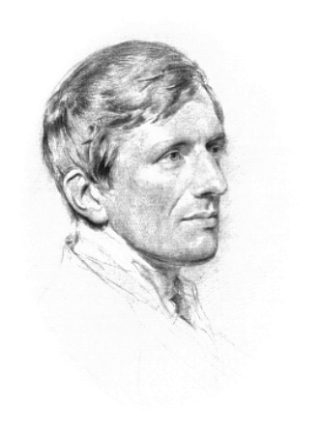 1844
1844 Portrait of Newman from the excellent Newman Reader.
A lesser-known sight...
I trust that a post-retreat glow is evident... Anyway, before I went on retreat, I spent an enjoyable few hours about the city with Lauren of the Cntyr 'blog (who double-'blogs) and re-encountered one of those curiosites that one learns about as a resident of a city, but which don't make it into the guide-books. Coming down from Santa Sabina we passed an iron gateway leading into a private house. (Anyone wishing to locate it will find it on the Via S.Anselmo, about a third of the way up, on one's right as one ascends the Aventine.) The gateway is decorated with a crest and an inscription in Latin. The house itself is said to have been the home of an excommunicate priest who refused to recant various modernist propositions early in the last century. Deprived of his living (as the Anglicans might put it...) he withdrew to his home on the Aventine and as his parting shot to the world (and the Supreme Gatekeeper's successor) he erected this gate bearing his coat of arms and the motto 'Sine spe, sine metu - 'Without hope, without fear.'
Wednesday, October 06, 2004
'Blog break...
Going on retreat for the next few days... No more posting until Sunday/Monday.
Oremus pro invicem
Oremus pro invicem
The Bad Popes...
One of the more interesting books I have read of late is Russell Chamberlain's 'The Bad Popes'. This exceptionally readable book covers the period from senatrix Marozia's domination of the Papcy (the so-called 'Pornocracy') in the 10th century to the sack of Rome by the troops of Charles V. In between one finds an account of Medicis, Borgias, the ineffectual hermit-Pope Celestine V and the extraordinary tale of Gregory VI, probably the most moral man ever to 'purchase' the Papacy. Yet despite looking at what might seem to be fodder for anti-Catholicism, Chamberlain's approach is very fair. He does not overplay the more lurid aspects of the tale and is sometimes surprisingly generous in his assesment of men who are often totally villified. He also makes excellent use of contemporary sources to give a genuine flavour of the period, whilst never failing to bear in mind the agendas at work in any contemporanious account. Of particular interest are the snippets gleaned from the diary of John Burchard, Papal Master of Ceremonies in the late 15th century. All in all, this is any enjoyable and informative read.
In a related vein...
It might be asked whether Chamberlain covers the lowst point of Papal history. I have heard it argued (I'm not inclined to agree myself) that the lowest point of all was the vacillation of Clement XIV over the supression of the Jesuits. Elected on a promise to suppress them, he then tried to escape this promised before finally being forced to do so in 1773 with the brief 'Dominus ac Redemptor'. Clement himself is buried in the Franciscan Church of XII Apostoli. Ironically, it is within short walking distance of the Pontifical Gregorian University, the Jesuit university in Rome. According to custom, every February and June students from the university gather around his tomb and read the brief of supression before facing their Jesuit examiners. There is also a Jesuit residence adjacent to the church, and according to legend, the Jesuits contrived to ensure that the room in the building nearest to Clement's remains was a lavatory.
In a related vein...
It might be asked whether Chamberlain covers the lowst point of Papal history. I have heard it argued (I'm not inclined to agree myself) that the lowest point of all was the vacillation of Clement XIV over the supression of the Jesuits. Elected on a promise to suppress them, he then tried to escape this promised before finally being forced to do so in 1773 with the brief 'Dominus ac Redemptor'. Clement himself is buried in the Franciscan Church of XII Apostoli. Ironically, it is within short walking distance of the Pontifical Gregorian University, the Jesuit university in Rome. According to custom, every February and June students from the university gather around his tomb and read the brief of supression before facing their Jesuit examiners. There is also a Jesuit residence adjacent to the church, and according to legend, the Jesuits contrived to ensure that the room in the building nearest to Clement's remains was a lavatory.
Monday, October 04, 2004
I am not an Anglican, nor was meant to be...
... but on occasion I derive great pleasure from Project Canterbury, an electic repository of Anglican texts. My latest discovery is the gently humourous My Curates by 'A Rector'. Despite being over 100 years old, I suspect that many of Rev. John Smith's observations could be applied to not a few Catholic Curates. (I believe several young clergymen affect what is termed "a clerical voice," which they trust in time to exchange for an episcopal one.
I was particularly taken by the following anecdote:
That 18th clause (I hardly need tell you) reads 'And yet they [the Persons of the Blessed Trinity] are not three Lords but one Lord.'
Consulting my 1953 edition Rituale Romanum (purchased in a moment of weakness) I note that the Athanasian Creed (or the 'Quicumque vult' as we Catholics are wont to call it) formed part of the Ritus Exorcizandi Obsessos A Daemonio. It was (is) recited immediately after the Magnificat and Benedictus which follow the prayer of exorcism. According to this article critical of the 1999 rite of exorcism this use of the Athanasian creed in the pre-1999 rite was the last surviving liturgical use of the 'Quicumque vult'.
On a completely unrelated note...
The photo archives of Corriere della Sera include a picture of this laudable Chinese religious practice. There they burn (amongst other things) mobile phones and video games as offerings to their dead - I've often thought that in a Christian context that phones which ring in church should be consigned to the flames.
Also from last month is this curious attempt by Brazilian soldiers to make an image of Pope John Paul II.
I was particularly taken by the following anecdote:
At the age of thirty I accepted a small living in the gift of the Dean and Chapter of our Cathedral. After some years, the parish of S. Peter's, Mulworth, was presented to me. From this I have retired to my present Cure, which is in the gift of our Bishop. For him I have a sincere regard, and I think it but proper and courteous to address him as "My Lord." Why should I not? It is a customary mode of address, and a term of respect due to the chief Pastor of the Diocese. The title is given to Roman Catholic prelates out of deference to the office of Bishop; so that, apart from legal arguments or Parliamentary considerations, there need be no qualms of conscience in using the phrase. And if we come to derivations, what is the meaning of "Lord" but "bread-dispenser?" Surely such is a most applicable designation for a Bishop.
Of course, there can be a lavish overplus in the use of the expression, which savours of obsequiousness as well as pleonasm. For example, when dining lately with our Bishop, I heard a New Zealand Missionary say, "My Lord, what is your Lordship's opinion of the Bill your Lordship is introducing into Convocation?" Nobody disliked the redundancy more than did the Bishop himself. The question reminded me—for alas! profane thoughts will beset us—of the eighteenth clause in the Athanasian Creed.
That 18th clause (I hardly need tell you) reads 'And yet they [the Persons of the Blessed Trinity] are not three Lords but one Lord.'
Consulting my 1953 edition Rituale Romanum (purchased in a moment of weakness) I note that the Athanasian Creed (or the 'Quicumque vult' as we Catholics are wont to call it) formed part of the Ritus Exorcizandi Obsessos A Daemonio. It was (is) recited immediately after the Magnificat and Benedictus which follow the prayer of exorcism. According to this article critical of the 1999 rite of exorcism this use of the Athanasian creed in the pre-1999 rite was the last surviving liturgical use of the 'Quicumque vult'.
On a completely unrelated note...
The photo archives of Corriere della Sera include a picture of this laudable Chinese religious practice. There they burn (amongst other things) mobile phones and video games as offerings to their dead - I've often thought that in a Christian context that phones which ring in church should be consigned to the flames.
Also from last month is this curious attempt by Brazilian soldiers to make an image of Pope John Paul II.
Sunday, October 03, 2004
Angel of God, my guardian dear...
I had expected to see a little bit more on Guardian Angels about the Catholic Blogosphere yesterday, so to rectify that I thought I'd post a snippet from Newman's Dream of Gerontius wherein the guardian angel reflects on his sacred mission:
Then was I sent from heaven to set right
The balance in his soul of truth and sin,
And I have waged a long relentless fight,
Resolved that death-environ'd spirit to win,
Which from its fallen state, when all was lost,
Had been repurchased at so dread a cost.
Oh, what a shifting parti-colour'd scene
Of hope and fear, of triumph and dismay,
Of recklessness and penitence, has been
The history of that dreary, life-long fray!
And oh, the grace to nerve him and to lead,
How patient, prompt, and lavish at his need!
O man, strange composite of heaven and earth!
Majesty dwarf'd to baseness! fragrant flower
Running to poisonous seed! and seeming worth
Cloking corruption! weakness mastering power!
Who never art so near to crime and shame,
As when thou hast achieved some deed of name;—
How should ethereal natures comprehend
A thing made up of spirit and of clay,
Were we not task'd to nurse it and to tend,
Link'd one to one throughout its mortal day?
More than the Seraph in his height of place,
The Angel-guardian knows and loves the ransom'd race.
Friday, October 01, 2004
Quid distat inter Scottum et sottum?
I recently heard recounted the tale that Charles the Bald was in the habit of holding drinking competitions with his court philosopher John Scotus Eriugena. It is said that they would sit opposite each other and quaff until one or other yielded to intoxication. Once, the emperor asked 'What seperates a Scot from a sot?' Despite being in his cups, the philosopher quickly replied 'the table'.
One of the great things about the internet is the fact that one can check whether the reparte translates into Latin, and so it does!
Even better,this page actually gives a 12th century citation for the anecdote.
One of the great things about the internet is the fact that one can check whether the reparte translates into Latin, and so it does!
Quid distat inter Scottum et sottum?
Tabula tantum!
Even better,this page actually gives a 12th century citation for the anecdote.
Greetings...
Emily of the Holy Whapping casually drops a hint that today's her 21st Birthday. In her honour I present one of the finest drinking songs ever written, the aptly named Drinking Song by the Divine Comedy. (To my mind, their second and third albums Liberation and Promenade are just about as good as modern music gets - who else sings Wordsworth?)
Why I'm Sticking to Bottled Water
And while I'm in the congratulatory mood, I'd better mention the good news of Jamie of Ad Limina Apostolorum and his wife. Following closely on the heels of Zorak and Oligarch's announcement I'm beginning to think that there's something in the water supply.
Well, bloody my nose
And blacken my eye
If it ain't some young Turk
In search of a fight
And chanticleer's chest
Is sagging with pride
For honour has yet
To be satisfied
Why I'm Sticking to Bottled Water
And while I'm in the congratulatory mood, I'd better mention the good news of Jamie of Ad Limina Apostolorum and his wife. Following closely on the heels of Zorak and Oligarch's announcement I'm beginning to think that there's something in the water supply.
News from Corriere della Sera & The Telegraph
It seems that in addition to Mother's Day and Father's Day, the people of Lombardy have begun celebrating Grandparents' Day. The 'festa dei nonni' celebrates the role of grandparents in 'the transmission of wisdom and experience of life and death.'
They also publish this picture of hostage Kenneth Bigley's wife praying in a Buddhist temple in Thailand. Mrs Bigley has made a vow that she will be come a nun (Buddhist, presumably) if her husband is freed. They also include this shot from China of a man balancing a 150 kilo car on his head.
Over at the Telegraph we have this story about a missing page being restored to the Sforza Book of Hours.
They also publish this picture of hostage Kenneth Bigley's wife praying in a Buddhist temple in Thailand. Mrs Bigley has made a vow that she will be come a nun (Buddhist, presumably) if her husband is freed. They also include this shot from China of a man balancing a 150 kilo car on his head.
Over at the Telegraph we have this story about a missing page being restored to the Sforza Book of Hours.
A special guest...
It is fitting that on this the 1st of October, Feast of St. Thérèse of the Child Jesus and the Holy Face, that we welcome the relics of St.Thérèse to Rome.

She will be arriving this evening at the church of S. Lorenzo in Lucina at 21.00 at which time mass will be celebrated by one of the auxiliary bishops of Rome. To the best of my knowledge, the relics will remain in the church for veneration for the next week or so.
This is not, of course, her first time to visit Rome. One of the most touching moments of her life was when she begged Pope Leo XIII to be allowed enter Carmel despite being below the canonical age.
I also understand that her relics have previously visited the Russicum, or Russian College. It is a curious fact that this college is dedicated to St. Thérèse. Despite having no overt connection with Russia, her great zeal for souls as a contemplative earned her the patronage of the missions and the Russicum itself was funded from the surplus funds of the cause of St. Thérèse.
There is a nice gallery of pictures here.
May St. Thérèse pray for us!

She will be arriving this evening at the church of S. Lorenzo in Lucina at 21.00 at which time mass will be celebrated by one of the auxiliary bishops of Rome. To the best of my knowledge, the relics will remain in the church for veneration for the next week or so.
This is not, of course, her first time to visit Rome. One of the most touching moments of her life was when she begged Pope Leo XIII to be allowed enter Carmel despite being below the canonical age.
I also understand that her relics have previously visited the Russicum, or Russian College. It is a curious fact that this college is dedicated to St. Thérèse. Despite having no overt connection with Russia, her great zeal for souls as a contemplative earned her the patronage of the missions and the Russicum itself was funded from the surplus funds of the cause of St. Thérèse.
There is a nice gallery of pictures here.
May St. Thérèse pray for us!
Subscribe to:
Comments (Atom)