Back from Siena... Had a great time... Too tired/busy to 'blog...
Go get some fresh air!
Friday, June 25, 2004


Wednesday, June 23, 2004
From 'Matt's Book'
I mentioned below a new English 'translation' of the New Testament. Despite the fact that I should be doing something more constructive, I couldn't refrain from commenting on some extracts from their version of St. Mathhew's Gospel.
We flick on, and read about the 'star gazers' (Magi) who have decided to visit the Holy Family in their crib.
I could go on...
Matt 1Well, it's nice that we don't have to read through that boring geneology when those 15 verses can be reduced to one. I'm not sure that I remember a character called 'Boat' from the Old Testament. Maybe it's a reference to Noah's Ark.
Jesus, God's Chosen, has an impressive pedigree. His ancestors include Abraham, (2-16) Isaac, Jacob, Judah and his daughter-in-law Tamar; Rahab (the Caananite prostitute), Ruth and Boat, King David and Bathsheba (the wife David stole from Uriah), King Solomon, and many other kings, priests and leaders. Jesus came from this line through Joseph, husband of Mary. They were the parents of Jesus, God's Chosen.
We flick on, and read about the 'star gazers' (Magi) who have decided to visit the Holy Family in their crib.
Matt 2Oooh! Money, medicine and perfume! That's such an evocative and symbolic set of gifts. Money, because that's what makes the world go round (a very appropriate gift for the Eternal Logos throgh whom all things were made), medicine (because we know that babies got sick a lot back then) and perfume (because even the Virgin Mother of God likes to hit the discos every now and again). Alternatively, that perfume could be a sign of the welcome and tolerance which should be extended to the transgendered community.
11) They went inside the house and met him and his mother and expressed their pleasure at the honour they felt. They took out from their luggage the presents they had brought with them including money, medicine and perfume. (12) They had a hunch it would be a mistake to go back to Herod, so they took a different route back home.
Matt 3A simple lifestyle?!? I am seriously underwhelmed here! They make it sound like John the Baptist was the sort of chap who lived frugally, recycled and bicycled everywhere. And what's this carob nuts and tree sap nonsense about? The dude ate locusts and wild honey! John the Baptist was the kind of ass-kicking ascetic prophet who thought nothing of dwelling in the wilderness and taking on a decadent and corrupt king on an issue of sexual morality and public scandal. Why would anyone want to make him sound like a tree-hugging, museli-chewing environmentalist.
(4) John had a simple lifestyle, wearing only a camel skin with a leather belt and eating carob nuts and tree sap
Matt 4Where's the Spirit gone? The Spirit is meant to drive Jesus out into the wilderness! I thought liberals liked the gender-neutral and liberating Spirit. It's no surprise that they left the whole 'tempted by the devil' business out, but did they have to replace it with 'to be clear in his mind which direction his life should take'... They're making it sound more like a counselling session than the temptation in the wilderness.
Jesus felt he needed to spend some time in the desert to be clear in his mind which direction his life should take.
I could go on...
Here comes 'Jack the Dipper'
Thanks to those good folks over at the comment box of Titusonenine (an excellent Anglican 'blog) for drawing my attention to the latest religion-meets-pop-culture shenanigans.
A Benedictine of my acquaintance who taught Greek used to say that to understand the irony of renaming Simon as Peter we should think about how ironic it would be to call someone of his changeable temperament 'Rocky'. He also used to point out that modern translations had changed John the Baptist to John the Baptizer as being a somewhat more accurate, if less solemn, title. He'd then add the quip 'at least they're not calling him Jack the Dipper'.
Well, according to this article (which seems to be genuine!), an Englishman has brought out a new translation of the New Testament with such gems as
Edited to add: I can't believe that the first time I read through that Ekklesia article, I missed that they're also including the non-canonical 'Gospel of Thomas'! Also, here's their version of Matt 1-4 on which I comment here
A Benedictine of my acquaintance who taught Greek used to say that to understand the irony of renaming Simon as Peter we should think about how ironic it would be to call someone of his changeable temperament 'Rocky'. He also used to point out that modern translations had changed John the Baptist to John the Baptizer as being a somewhat more accurate, if less solemn, title. He'd then add the quip 'at least they're not calling him Jack the Dipper'.
Well, according to this article (which seems to be genuine!), an Englishman has brought out a new translation of the New Testament with such gems as
“John, nicknamed ‘The Dipper’, was ‘The Voice’. He was in the desert, inviting people to be dipped, to show they were determined to change their ways and wanted to be forgiven.” (Mk 1:4)Surprisingly, this has got the informal imprimatur (sorry, I mean 'thumbs up') of Rowan Williams. Best of all, for those of you who are sick and tired of repressive Biblical morality
As he was climbing up the bank again, the sun shone through a gap in the clouds. At the same time a pigeon flew down and perched on him. Jesus took this as a sign that God’s spirit was with him. A voice from overhead was heard saying, ‘That’s my boy! You’re doing fine!’” (Mk 1:10-11)
"Instead of condemning fornicators, adulterers and 'abusers of themselves with mankind'," says Ruth Gledhill, the Times Religious Affairs correspondent, "the new version of his first letter to Corinth has St Paul advising Christians not to go without sex for too long in case they get 'frustrated'."One wonders how well that justification would go down in the confessional!
Edited to add: I can't believe that the first time I read through that Ekklesia article, I missed that they're also including the non-canonical 'Gospel of Thomas'! Also, here's their version of Matt 1-4 on which I comment here
Credibility
Thanks to Mark Shea for drawing my attention to this post on Credibility, a 'blog I hadn't previously come across. Bravo to the author for dealing with abortion so well in his RE class. I see also that the author posted this about World Youth Day 2000. The top picture comes from the Basilica of S.Maria degli Angeli, where Cardinal Bernard Law and (then) Archbishop Cormac Murphy-O'Connor gave cathechesis. I know that Cardinal Law is (perhaps deservedly) somewhat of a bete-noir amongst American Catholics, but to his credit, I know for a fact that his powerful cathechesis proved a decisive influence on several young people regarding their vocational journeys.
Interesting quotation...
A correspondant sends me this quote from a book he's reading on Ottoman history:
"A Venetian ambassador, Gianfrancisco Morosini, visited an Ottoman warAlso, the Corriere della Sera's English section has a brief article on the woes of S.Giovanni Rotundo.
camp in 1585. he wrote to the Doge, "I walked through the whole army and
carefully observed every detail about the calibre of their men, their
weapons, and the way they organised and fortified their camp. I think I
can confidently offer this conclusion: they rely more on large numbers and
obedience than they do on organization and courage" He went on to say that
"10,000 Christians could defeat 30,000 Turks, but that it would be harder
to govern 2,000 Christians than 100,000 Turks - much harder again if the
Christians were Italians."
Tuesday, June 22, 2004
Anti-drug monks on horseback...
This is a great picture. The caption reads: Monks Against Drugs - Thai monks and novices travel by horse on the Thai-Burmese border. They travel hundreds of kilometres passing through villages where they help drug-addicts to rehabilitate themselves in a region which for decades has been the centre of opium and heroin production.
Misc., etc...
Two strange school-related stories from the Daily Telegraph - in the first we learn of a Japanese student who was required to write an essay in his own blood:
Arbitrarily, here's a page on how to make a Bishop's Mitre. Unfortunatly, it's a napkin-folding website, rather than a page about vestment manufacture, but interesting nonetheless.
Finally, a picture of my favourite girl, whom I hope to visit in Siena later this week. :)
The 17-year-old was given a boxcutter and a piece of paper and told by the teacher to write "not in pencil, but in blood" because he was not sufficiently repentant.Meanwhile, in England, it seems that a primary school teacher commissioned an army of nine-year-old girls to administer corporal punishment.
Arbitrarily, here's a page on how to make a Bishop's Mitre. Unfortunatly, it's a napkin-folding website, rather than a page about vestment manufacture, but interesting nonetheless.
Finally, a picture of my favourite girl, whom I hope to visit in Siena later this week. :)

Monday, June 21, 2004
What on earth is this???
I see that the Archdiocese of Los Angeles had a mass 'in honor' of the late President Reagan! I hope that this is some kind of infelicity of wording on behalf of a careless journalist.
Putting aside the fittingness or otherwise of holding a Requiem Mass for a deceased non-Catholic, I hardly think the service as described sounds very fitting. It almost sounds as though he has been canonized! It's no wonder that so many Catholics are confused as to the 'last things'.
It is a holy and a holy thing to pray for the dead.
Putting aside the fittingness or otherwise of holding a Requiem Mass for a deceased non-Catholic, I hardly think the service as described sounds very fitting. It almost sounds as though he has been canonized! It's no wonder that so many Catholics are confused as to the 'last things'.
It is a holy and a holy thing to pray for the dead.
Welcome surfer...
I'm always really jealous of other 'blogs that have visits from really bizarre google (or equivalent) searches. Alas, I've had nothing overly exciting so far, though I am mildly curious as to what the Lituanian surfer who found me though a search for oath of allegiance liturgia was after.
Anyway, in unrelated matters, the perennial ducks crossing street photo makes its appearance on the Corriere della Sera website. Also worth a peep is the slideshow of the new-age solstice rites at Stonehenge. (Don't forget to click the '2' button at the top left corner to see the second page of pictures.) Also check out this
Vietnamese chap whose hair is over 6 metres (c.18 feet) long. Not bad for 31 years unrestrained growth.
In keeping with the general theme of 'Zadok has nothing interesting to say, so he'll just keep linking to interesting photos', engrish.com has this piece of garbled English which has a tenuous religious connection.
Finally, those of you interested in LITURGIA should check out these pages which show how the dedication of a church was performed before the simplification of these rites. ('Bring back the Gregorian Water,' says I!)
Anyway, in unrelated matters, the perennial ducks crossing street photo makes its appearance on the Corriere della Sera website. Also worth a peep is the slideshow of the new-age solstice rites at Stonehenge. (Don't forget to click the '2' button at the top left corner to see the second page of pictures.) Also check out this
Vietnamese chap whose hair is over 6 metres (c.18 feet) long. Not bad for 31 years unrestrained growth.
In keeping with the general theme of 'Zadok has nothing interesting to say, so he'll just keep linking to interesting photos', engrish.com has this piece of garbled English which has a tenuous religious connection.

Finally, those of you interested in LITURGIA should check out these pages which show how the dedication of a church was performed before the simplification of these rites. ('Bring back the Gregorian Water,' says I!)
This is twisted...
Thanks to my near-namesake Zorak for drawing my attention to the latest piece of irony hypocrisy perpetuated by the pro-abortion lobby in the States. They are encouraging folks to send their fathers (for goodness' sakes) 'pro-choice' e-cards for Father's Day. An example is this image

which was accompanied by the slogan When Your Dad Deserves the Very Best. Might I humbly suggest that a more fitting title would be The One that Got Away?
which was accompanied by the slogan When Your Dad Deserves the Very Best. Might I humbly suggest that a more fitting title would be The One that Got Away?
Sunday, June 20, 2004
Another Great Cartoon from Giannelli
Here. To explain, 'UE' is the Italian abbreviation for the European Union, and Chriac is saying 'It doesn't do anything but cry!'. The reference is to the new European Constitution which I am not mightily pleased with. To my mind, the European Community would have been of far more good had it remained the 'European Economic Community', a free-trade area capable of offering assistance to the poorer countries of Europe. Instead we seem to be cooking up some kind of dictatorial and overly beaurocratic superstate.
Theological Debate...
There's an interesting Theological Debate going on in the comments box of my post on the Sacred Heart, if that's the kind of thing that interests you. Is it appropriate to worship the Sacred Heart of Jesus?
To my mind it follows from the Council of Chalcedon, but not all seem to hold it apt.
To my mind it follows from the Council of Chalcedon, but not all seem to hold it apt.
Saturday, June 19, 2004
Harry Potter... Now in Ancient Greek.
"It's an ideal job for an old bloke in retirement." Peter Needham, translator of HP into Latin.
Quite! More info here.
Quite! More info here.
À la folie... pas du tout
I recently watched this film and heartily recommend it.
I presume that my readers are familiar with Audrey Tautou from that gem of a film Amélie. (If not, then why not?) Well, in À la folie... pas du tout Tautou subverts the delightful naiveity of Amélie for a much darker character. She plays Angelique who is besotted with Loïc, a married doctor whose wife is 5 months pregnant. We see their affair develop from Angelique's point of view and chart her increasing agitation and despair as he seems to spurn her advances. Then we see the whole story again from his point of view.
This is not a feelgood movie, though it is very pleasant to watch. It is shot beautifully, taking full of Tautou's talent for facial expression. The film also makes a nice change from the usual approach to adultery (It's alright if they love eachother enough), though it's not a simple morality play. The English title for the film is He Loves Me, He Loves Me Not. It seems that the French title (which I would translate as 'Madly... Not at All') is a reference to a game played with a flower similar to our 'Loves me, loves me not'. However, when a Frenchgirl is plucking petals, she doesn't alternate between 'loves me', 'loves me not'. Instead she goes:
I presume that my readers are familiar with Audrey Tautou from that gem of a film Amélie. (If not, then why not?) Well, in À la folie... pas du tout Tautou subverts the delightful naiveity of Amélie for a much darker character. She plays Angelique who is besotted with Loïc, a married doctor whose wife is 5 months pregnant. We see their affair develop from Angelique's point of view and chart her increasing agitation and despair as he seems to spurn her advances. Then we see the whole story again from his point of view.
This is not a feelgood movie, though it is very pleasant to watch. It is shot beautifully, taking full of Tautou's talent for facial expression. The film also makes a nice change from the usual approach to adultery (It's alright if they love eachother enough), though it's not a simple morality play. The English title for the film is He Loves Me, He Loves Me Not. It seems that the French title (which I would translate as 'Madly... Not at All') is a reference to a game played with a flower similar to our 'Loves me, loves me not'. However, when a Frenchgirl is plucking petals, she doesn't alternate between 'loves me', 'loves me not'. Instead she goes:
Il m'aime un peu, beaucoup, à la folie,pas du tout, etc...which probably says a lot about the French.
i.e. He loves me a little, a lot, madly, not at all...
Tertullian...
I recently stumbled across the very interesting (if you have an interest in Patrology) Tertullian Project, a site run by Roger Pearse, a British software consultant with an interest in Tertullian.
Quintus Septimus Florens Tertullianus is one of the most interesting and tragic figures of patristic times. Born in Carthage in about 160, attracted by the witness of martyrs, he converted to Christianity in 197. His background as a lawyer made him a particularly clear thinker and writer for the Chrsitian cause; amongst his works are apologitics addressed to pagans and Jews, dogmatic polemics against gnostics and heretics and treatises on ethical and aesetical matters. He was the first Latin ecclesiastical writer (remember, Greek was the lingua franca of most Christians, even in Rome) and he contributed literally hundreds of neologisms to express Christian thought in Latin.
However, his legalistic and rigorist approach (typical of North African Christianity) was to be his downfall. He rejected Christian participation in many aspects of Roman society and was notoriously hostile to philosophical thought, posing the question 'What has Athens to do with Jerusalem?' He was unable to accept what he saw as the laxist approach of the institutional church with regards to forgiveness of sins and penance and by 207 was drawn towards Montanism, an early 'charismatic' movement which rejected the institutional church in favour of new prophesies. The 'real' church consisted, not of the bishops and their flocks, but the 'spiritual men' who were uncompromising in their morality. (Curiously, Montanus himself seemingly claimed to be an incarnation of the Holy Spirit.) By 213, Tertullian had totally broken from the institutional church and this coupled with his unorthodox later teaching means that he must be counted amongst the Ecclesiastical Writers rather than the Church Fathers. It's also easy to see traces of what would become Donatism in the thought of Tertullian. However, he rightly deserves his place as one of the great Christian thinkers and as an influence on the North African Christian environment which brought forth St. Augustine. In Tertullian we find the basis for the orthodox formulation of the doctrine of the Trinity and the incarnation. The great St. Cyprian (c.210-258) read his works daily, referring to him as 'The Master'. Tertullian vanishes quietly from history about 220, presumably dying of natural causes.
Quintus Septimus Florens Tertullianus is one of the most interesting and tragic figures of patristic times. Born in Carthage in about 160, attracted by the witness of martyrs, he converted to Christianity in 197. His background as a lawyer made him a particularly clear thinker and writer for the Chrsitian cause; amongst his works are apologitics addressed to pagans and Jews, dogmatic polemics against gnostics and heretics and treatises on ethical and aesetical matters. He was the first Latin ecclesiastical writer (remember, Greek was the lingua franca of most Christians, even in Rome) and he contributed literally hundreds of neologisms to express Christian thought in Latin.
However, his legalistic and rigorist approach (typical of North African Christianity) was to be his downfall. He rejected Christian participation in many aspects of Roman society and was notoriously hostile to philosophical thought, posing the question 'What has Athens to do with Jerusalem?' He was unable to accept what he saw as the laxist approach of the institutional church with regards to forgiveness of sins and penance and by 207 was drawn towards Montanism, an early 'charismatic' movement which rejected the institutional church in favour of new prophesies. The 'real' church consisted, not of the bishops and their flocks, but the 'spiritual men' who were uncompromising in their morality. (Curiously, Montanus himself seemingly claimed to be an incarnation of the Holy Spirit.) By 213, Tertullian had totally broken from the institutional church and this coupled with his unorthodox later teaching means that he must be counted amongst the Ecclesiastical Writers rather than the Church Fathers. It's also easy to see traces of what would become Donatism in the thought of Tertullian. However, he rightly deserves his place as one of the great Christian thinkers and as an influence on the North African Christian environment which brought forth St. Augustine. In Tertullian we find the basis for the orthodox formulation of the doctrine of the Trinity and the incarnation. The great St. Cyprian (c.210-258) read his works daily, referring to him as 'The Master'. Tertullian vanishes quietly from history about 220, presumably dying of natural causes.
Good News...
...over at Papa Familias's 'blog.
Truly sons are a gift from the Lord,
a blessing, the fruit of the womb.
Indeed the sons of youth
are like arrows in the hand of a warrior.
O the happiness of the man
who has filled his quiver with these arrows!
He will have no cause for shame
when he disputes with his foes in the gateways.
Ps.126(127)
Friday, June 18, 2004
Overheard Recently (Patrology Humour)
"Origen was a good man, his heart was in the right place, just like most of his other organs."
No, I'm not going to explain it...
No, I'm not going to explain it...
Cor Iesu, patiens et multae misericordiae, miserere nobis...
Today we celebrate the Feast of the Sacred Heart. The Catholic Encyclopedia has a good article on devotion to the Sacred Heart, though surpsrising fails to mention the importance of devotion to the Sacred Heart of Jesus in the fight against Jansenism. Fr John Hardon SJ wrote this short article on the doctrinal basis of the devotion, whilst probably the most important magisterial document in this regard is Pius XII's Haurietis Aquas. Amongst the wonderful passages from the later, I'm particularly taken by:
59. Hence His words, actions, commands, miracles, and especially those works which manifest more clearly His love for us—such as the divine institution of the Eucharist, His most bitter sufferings and death, the loving gift of His holy Mother to us, the founding of the Church for us, and finally, the sending of the Holy Spirit upon the Apostles and upon us—all these, We say, ought to be looked upon as proofs of His threefold love.Newman's prayer to the Sacred Heart can be found here, whilst the traditional Litany of the Sacred Heart attracts a partial indulgence.
60. Likewise we ought to meditate most lovingly on the beating of His Sacred Heart by which He seemed, as it were, to measure the time of His sojourn on earth until that final moment when, as the Evangelists testify, "crying out with a loud voice 'It is finished.', and bowing His Head, He yielded up the ghost."[56] Then it was that His heart ceased to beat and His sensible love was interrupted until the time when, triumphing over death, He rose from the tomb.
61. But after His glorified body had been re-united to the soul of the divine Redeemer, conqueror of death, His most Sacred Heart never ceased, and never will cease, to beat with calm and imperturbable pulsations. Likewise, it will never cease to symbolize the threefold love with which He is bound to His heavenly Father and the entire human race, of which He has every claim to be the mystical Head.
Thursday, June 17, 2004
More Motorcycle Funerals...
Reverendissimo Sibley posted details of an English Motorcycle Hearse Service a whilke back.
Well, today's Corriere della Sera has this picture of Tom Maitland (Clio, MI) transporting the casket of his deceased friend Ron Lash. Mr Lash was killed in a motorcycle accident last Saturday.
Also, just for kicks, here's a picture from last November of a giraffe fighting a buffalo.
Well, today's Corriere della Sera has this picture of Tom Maitland (Clio, MI) transporting the casket of his deceased friend Ron Lash. Mr Lash was killed in a motorcycle accident last Saturday.
Also, just for kicks, here's a picture from last November of a giraffe fighting a buffalo.
Redundancy for CoE Bishops?
This Daily Telegraph Article discusses the possibility of the Church of England trimming its hierarchy. I have to say that it really annoys me when I hear terms such as 'top jobs' with reference to Bishops. Can we not even seek to maintain the illusion that it might be about ministry and that a bishop's role is more than just a Senior Executive?
Also, note the following:
Also, note the following:
The meeting was chaired by the Archbishop of Canterbury, Dr Rowan Williams, who is anxious to divert hard-pressed resources into boosting churchgoing.Poor Venerable Newman must be spinning in his grave at the likes of that. Even though he had no illusions about the status of the (Roman) Catholic Church as the One True Church, he did hold that there was much good within the CoE and that it served to preserve Christianity in England until such time as the Catholic Church could assume the CoE's mantle. (Out of justice's sake, I'd better mention that he's probably not too chuffed at lots of stuff going on in the Catholic Church these days too...)
He is keen to promote schemes to attract new worshippers, from cafe churches where services include coffee and croissants to "raves in the nave".
Wednesday, June 16, 2004
Priests' Problems & Mass on the Hindenburg. Also Corpus Christi Pictures.
I mentioned previously that I enjoy flicking through volumes containing the questions and answers published in clerical magazines in the first half of the last century. Whilst to our eyes it may seem slightly ridiculous that the clergy of an earlier generation got so worked up about what seem to be minor issues (Is it allowed for the room above an oratory in a rectory to be used as a bedroom?), but I am not infrequently of the mind that today's clergy don't care enough about details (major and minor) in matters of liturgy, canon law and morality. An attention to detail, if not taken to extremes, normally betrays a genuine concern and diligence in these matters.
Anyway, my latest discovery is a 1958 volume entitled
One presumes that last clause excludes St. Joseph of Cupertino.
Now availible on the Vatican website are the pictures from the Pope's Corpus Christi procession. If you look closely you might see Zadok in this shot. :)
Anyway, my latest discovery is a 1958 volume entitled
PRIESTS' PROBLEMSAmongst the gems in this book is the question: Would a priest enjoying a portable altar indult, which included celebration in a ship, violate any grave law by celebrating Mass in an aeroplane? In the course of the answer we discover: There is no express prohibition against celebrating in aeroplanes. On the contrary, it was expressly permitted by papal indult as long ago as 1936, on the voyage of the dirigible Hindenburg from Friedrichschafen to New York, and the celebrant Fr. Schulte O.M.I., is said to have been the first priest to celebrate in the air..
Being answers to a large variety of questions on points of moral, canonical, liturgical and rubrical interest
by the late
CANON E.J. MAHONEY, D.D.
Selected and edited by
REV. L.L. McREAVY, J.C.D., M.A
One presumes that last clause excludes St. Joseph of Cupertino.
Now availible on the Vatican website are the pictures from the Pope's Corpus Christi procession. If you look closely you might see Zadok in this shot. :)
In the absence of any original content...
...I direct you to the Corriere della Sera, where one can see the latest in Japanese sunglasses fashion. (Not for the faint of heart...)
Decorations on Professors' Doors...
Interesting link via E-Pression.
I once knew a chap who decorated his door with a reproduction of Carravaggio's St. Jerome from the Galleria Borghese. Underneath was the title Re-writing the Bible - Please DO NOT DISTURB. Needless to say, this proved too much temptation for a wag who altered it to read Bible Re-writing me.
I once knew a chap who decorated his door with a reproduction of Carravaggio's St. Jerome from the Galleria Borghese. Underneath was the title Re-writing the Bible - Please DO NOT DISTURB. Needless to say, this proved too much temptation for a wag who altered it to read Bible Re-writing me.

Tuesday, June 15, 2004
Arbitrary links...
Thanks to Mark Shea for drawing our attention to this bizarre music video.
The Web Gallery of Art is an excellent site for finding just about any famous painting by the great artists.
The Web Gallery of Art is an excellent site for finding just about any famous painting by the great artists.
How gullible do they think we are?
Zadok the Roman was gratified to receive this morning a letter from Lawrence Taylor, brother of deposed Liberian president and all-round bad-egg Charles Taylor. Unsurprisingly, Mr Taylor has $15.7m salted away in a 'private security vault' and is in need of a foreign partner to help launder this money in exchange for a 20% cut. Now, I'm not naturally of a suspicious nature, but this unforseen invitation to participate in this most irregular scheme did cause me to wonder - could this possibly be one of those 'Nigerian e-mail scams'? Thankfully Mr Taylor, as a sign of good will, has recognised that I might doubt his word and so he puts my mind at rest:
We in no way comply to any messages that even slightly exude resemblance to the notoriety of the Nigerian letters of fraud that have fleeced so many unsuspecting good meaning people throughout the western world and elsewhere. Think of all the sufferings such fraudulent acts have brought upon thousands of people who now live lives of paupers! Know that all such attempts have now been branded and spammed internationally so that such kinds of letters are forwarded to a police centre to be kept on file for immediateinvestigation (sic) by Interpol no less. You have been braded by our site also.Best way is lead an honest way of life from now on! Invested in your country under your close supervision and direction, 20% for your efforts and the balance 5% would be for all unforeseen incidental expenses that would be incurred in pursuit of this transaction to a successful conclusion.Now isn't that reassuring! How could one not trust such a frank explaination?
More from Fine Arts Brass...
Another sound clip from Fine Arts Brass. Have you ever wanted to hear a particularly brisk rendition of the O Sanctissima played on brass instruments? I hadn't considered the question until I heard this and now I can't get it out of my head.
O sanctissima, O piissima,
Dulcis virgo Maria!
Mater amata, intemerata,
Ora, Ora, ora pro nobis.
Tu solatium et refugium,
Virgo mater Maria!
Quidquid optamus, per te speramus,
Ora, Ora, ora pro nobis.
Monday, June 14, 2004
Zadok the Priest...
I note that my post below has attracted a comment from the Old Oligarch, whose 'blog is the first I ever read. Now, he is a real theologian, as opposed to myself who just pretends to be one on the internet. That's why I can't answer his questions with anything more than a shrug of the shoulder. I thought that the generally accepted theory was that the Sadducees derived their name from Zadok, but beyond that I don't know.
Regarding the use of Psalm 110 (Dixit dominus), I'm no exegete. What I do note, however, is that it is used by Our Lord in his discussions with the Pharisees.
On a mostly unrelated note, part of the reason that this 'blog is so-called is because (unlike Melchizedek) Zadok has the honour of having his theme tune composed by Handel. (Link from Fine Arts Brass) This stately piece has been used at all British coronations since that of George II in 1727. I'm no fan of British royalty, but I have to admit that they seem to have taste in these matters, the funeral of the late Princess Diana excepted. I seem to remember reading that the rite of the Coronation of a Monarch is the Anglican liturgy was the one ceremony virtually untouched by the reformation (perhaps one of my knowledgable Anglican visitors could confirm...). I also seem to recall that for the coronation of Elizabeth II in 1953 both the firm which traditionally prepared the oil and the recipe for preparing said oil had failed to survive the blitz, and that the concoction they eventually came up with for the ceremony was said to have been 'foul-smelling'.
The Oligarch's question regarding the Saduccees and the possible etymology based on 'tsaddiq (righteous)' also reminds me of the Hasidim, a branch of Judaism primarily found in Eastern Europe. It is said that 'Hasidim' means 'the righteous', though Martin Buber suggests that 'those who keep the faith' is a better translation. Indeed, it is through Buber and his delightful work tales of the Hasidim that the parables and stories of this extraordinary group are so well known. It's a great book to flick though and the stories seem to provide enlightenment and puzzlement in more-or-less equal measure. Amongst the less obscure tales we have the following:
Regarding the use of Psalm 110 (Dixit dominus), I'm no exegete. What I do note, however, is that it is used by Our Lord in his discussions with the Pharisees.
Now while the Pharisees were gathered together, Jesus asked them a question, saying, "What do you think of the Christ? Whose son is he?" They said to him, "The son of David." He said to them, "How is it then that David, inspired by the Spirit, calls him Lord, saying,`The Lord said to my Lord, Sit at my right hand, till I put thy enemies under thy feet'? If David thus calls him Lord, how is he his son?" And no one was able to answer him a word, nor from that day did any one dare to ask him any more questions.I'm inclined to think that the way in which Christ used the scriptures Himself bears study. (I also note that the Vatican website includes the following commentary of Pope John Paul II as part of his series of reflections on the Psalms and Canticles of the office.)
On a mostly unrelated note, part of the reason that this 'blog is so-called is because (unlike Melchizedek) Zadok has the honour of having his theme tune composed by Handel. (Link from Fine Arts Brass) This stately piece has been used at all British coronations since that of George II in 1727. I'm no fan of British royalty, but I have to admit that they seem to have taste in these matters, the funeral of the late Princess Diana excepted. I seem to remember reading that the rite of the Coronation of a Monarch is the Anglican liturgy was the one ceremony virtually untouched by the reformation (perhaps one of my knowledgable Anglican visitors could confirm...). I also seem to recall that for the coronation of Elizabeth II in 1953 both the firm which traditionally prepared the oil and the recipe for preparing said oil had failed to survive the blitz, and that the concoction they eventually came up with for the ceremony was said to have been 'foul-smelling'.
The Oligarch's question regarding the Saduccees and the possible etymology based on 'tsaddiq (righteous)' also reminds me of the Hasidim, a branch of Judaism primarily found in Eastern Europe. It is said that 'Hasidim' means 'the righteous', though Martin Buber suggests that 'those who keep the faith' is a better translation. Indeed, it is through Buber and his delightful work tales of the Hasidim that the parables and stories of this extraordinary group are so well known. It's a great book to flick though and the stories seem to provide enlightenment and puzzlement in more-or-less equal measure. Amongst the less obscure tales we have the following:
The Greatness of Pharoh
Rabbi Levi Yitzak said:
"I envy Pharoh! What glorification of the Name of God did his stubbornness beget!"
Sunday, June 13, 2004
Corpus Christi
Buona festa! What a joy it is to celebrate this feast twice a year!
During the Mass and Office we also have the chance to hear the wonderful collect composed by St. Thomas Aquinas, which is also, of course, chanted at Benediction of the Blessed Sacrament:
During the Mass and Office we also have the chance to hear the wonderful collect composed by St. Thomas Aquinas, which is also, of course, chanted at Benediction of the Blessed Sacrament:
Deus, qui nobis sub sacramento mirabiliI fear that ICEL haven't done the prayer much justice but the linked page provides a variety of translations.
passionis tuae memoriam reliquisti,
tribue, quaesumus,
ita nos Corporis et Sanguinis tui sacra mysteria venerari,
ut redemptionis tuae fructum in nobis iugiter sentiamus.
Saturday, June 12, 2004
Miscellany
The Corriere della Sera marks what would have been Anne Frank's 75th Birthday with this photo taken in Amsterdam in 1941. also, the latest from Japan is this air-conditioned jacket. Stylish!
Chesterton notwithstanding, it seems that Prof Fomenko from yesterday's post seems to be an artist too! Scroll down the page for hyperlinks to some of his work.
The Compendium of Common Knowledge provides an interesting look at Elizabethan England, even if it is tainted with by occasionally mixing the blindly obvious with the undoubtedly incorrect. It's nice to know that instead of saying 'wow', the Elizabethan would have 'Fie me!', 'Marry!', ''Zounds', 'I'faith!', 'Hey-ho!', 'God's Death!' or 'What ho!'
Chesterton notwithstanding, it seems that Prof Fomenko from yesterday's post seems to be an artist too! Scroll down the page for hyperlinks to some of his work.
The Compendium of Common Knowledge provides an interesting look at Elizabethan England, even if it is tainted with by occasionally mixing the blindly obvious with the undoubtedly incorrect. It's nice to know that instead of saying 'wow', the Elizabethan would have 'Fie me!', 'Marry!', ''Zounds', 'I'faith!', 'Hey-ho!', 'God's Death!' or 'What ho!'
Friday, June 11, 2004
The Year of Our Lord 952AD??
Gentle reader, I genuinely consider myself of a rather unflappable nature. The follies of mankind rarely surprise me. I can accept that many misguided souls are willing to take Dan Brown's word about the 'Sacred Feminine' and the great Catholic plot to supress the truth. I can shrug my shoulders at the fact that a not insignificant number belive the moon-landings to be faked and deny the truth of the holocaust. If someone came up with a theory that all three were linked and flung the Protocals of the Elders of Zion and it was widely believed, I'd hardly bat an eyelid. It's also not something that surprises me when eminent experts in one field make fools of them in another - I've heard more than enough computer scientists trying to talk theology and recall a distinguished philosopher trying to pass himself off as a Newman expert when he was patently no such thing.
However, this surprised me. It should be some kind of practical joke, but I fear this guy is serious. Normally, I ignore the banner ads at the top of my 'blog, but couldn't resist having a peep at what was advertised by:
Equally intruiging on the Amazon site are the comments recorded by the reviewers and the publisher. The publisher has no hesitation in saying:
Amongst the gems we find a review's worldview in which historians are a secretive and wealthy cabal who are likely to engage in lethal force against Fomenko:
Apart from proving to me that Fomenko hasn't read Newman's Grammar of Assent which provides some sound argumentation as to why the traditional chronology just might be more-or-less correct and we might't afterall have to reconsider the antiquity of the Roman Forum, Pantheon, etc.. I am reminded of several things that Chesterton wrote in his wonderful book Orthodoxy. He notes, 'Mathematicians go mad, and cashiers; but creative artists very seldom. I am not, as will be seen, in any sense attacking logic: I only say that this danger does lie in logic, not in imagination.' He later explains:
However, this surprised me. It should be some kind of practical joke, but I fear this guy is serious. Normally, I ignore the banner ads at the top of my 'blog, but couldn't resist having a peep at what was advertised by:
Bible Updates HistoryIt turns out that Russian mathematician Anatoly T. Fomenko has applied astronomical and mathematical methods to historical documents and has managed to convince himself that the 'traditional' chronology of pre-Renaissance history is terifically mistaken. His main thesis seems to be that the surviving documentation of medieval and classical times consists entirely of copies and one therefore cannot justify faith in their antiquity. They are, he claims, forgeries, at least with respect to the alleged chronology. He seemingly seems to back this up with astronomical data. Amongst the conclusions he reaches are dates of 1053 AD and 1086 AD for the birth and death of Jesus Christ (neat the way he maintains the traditional 33 year life-span), identification of Troy with Constantinople, the claim that historical documents (deliberately?) confuse Old and New Rome and a re-interpretation of what Roman Numerals mean. Needless to say, this is an incident of scientific skepticism gone mad, combined with an uncommon lack of common sense.
Jesus Born 1053 & Crucified 1086 AD Proves New Chronology Research
Equally intruiging on the Amazon site are the comments recorded by the reviewers and the publisher. The publisher has no hesitation in saying:
No, Mr A.T. Fomenko, your theories are manifestly wrong; do not even try to convince us otherwise. The history never was, nor will it ever be a science - it is a proud profession. Our publishing house will gladly pay a premium of 10.000 dollars USA in cash to anyone who will prove with adequate methods and in sufficient detail that the theories of Anatoly T. Fomenko are not only preposterous and dangerous, but utterly and inherently wrong as well.What a postmodern point of view for a publisher to take! Reviewers mostly alternate between the tin-foil hat brigade who find fulfilment of their desires for a fresh conspiracy in Fomenko's work and the indignant defenders of the status quo whose rejections of these crackpot ideas rarely move beyond the polemical kneejeck.
Amongst the gems we find a review's worldview in which historians are a secretive and wealthy cabal who are likely to engage in lethal force against Fomenko:
It should hardly surprise us that historians demonstrate such bloodthirst when it comes to the brilliant Russian mathematician - if enough people begin to question the foundations of world history and find all the tremendous inconsistencies buried there, the historical profession shall cease to exist and make way for the new natural science. If Fomenko isn't eaten alive come that bright day, that is.Another reviewer bears all the marks of a relativististic conspiracy theorist. Alternative worldviews are good, the only reason they haven't been presented before is because of a conspiracy, perish the thought that truth, flasehood or credibilty might come into the equation:
If you can't handle an alternate view of history and how it may have been purposely kept from the general public, don't read this book. It is the best book I've ever read about history.Another review seems driven solely by suspicion:
Had no intention to buy this History initially. Then I saw the ultra-negative review entitled "Worthless". I looked into the contents of "Fiction or Science" just in case, for such vehement negation is bound to hide something. Was thoroughly impressed and bought it. Am reading it currently. Shocking, but really worth my dollars. According to Henry Ford, 'History is bunk'. The Russian mathematician seems to have proved it.Those review with a less positive account of the book are also very telling. It's rare these days to come across the word 'scoundrel' used so enthusastically.
Academician or not, this Fomeko character is a scoundrel and not a scientist, and deserves to be thrown into prison for attempted theft of human history.A singularily unimpressed German shouts:
IT IS SCANDALOUS TO LET SUCH A BOOK BE PUBLISHED!!! I CANT BELIEVE ALL THAT NONSENSE. AND ALL THE DIGNIFIED PEOPLE WHO SPENT THEIR LIVES AT STUDYING HISTORY?? THAT FOMENKO MUST NOT TELL SUCH HORRIBLE LIES ABOUT OUR HISTORY! HE MUST NOT DESTROY THE BELIEF IN OUR PAST! I AM SHOCKED AND DISGUSTED TO SEE THAT HERE IN FORMER EAST GERMANY FOMENKO AND HIS NEW CHRONOLOGY IS EXTREMELY HIGH ON DEMAND THAT PEOPLE EVEN MAKE ILLEGAL COPIES AND TRANSLATIONS OF HIS WORKS! WE HAD SOVIET YOKE, NOW THIS AWFUL RUSSIAN IS TROUBLING THE SPIRITS HERE!! ITS A SCANDAL!!It's rare to see such concern for 'dignified people'. One reviewer challenges a ridiculous thesis of Fomenko with an equally unimpressive refutation:
In the middle of a lot of forced texts, the first think that made me laugh the most was the fact that, 16th century paintings depicting Classic age personalities were painted in 16th century style, thus proving that there was no middle ages.whilst another totally misses Fomenko's point by suggesting that the Koran could solve the problem:
Even high school children can see that renaissance painters painted using their imagination, because therer were no archaelogical findings to sho how the ancient dressed and most of the painters had no formation in the classics.
If I use this reasoning, maybe we can say that the americas wrere only discovered in the 19 th century since all paintings and drawings between the 15 to 18 century were innacurate in the depiction of the florsa and fauna
The book claims that Jesus was born and crucified in the 11th Century. If that be the case, how can the author explain the numerous references to Jesus and Christians in the Koran, which was written in the 7th Century? There is even a whole chapter named after Mary!Doesn't he realise that those wily Arabs are in on the conspiracy too? Perhaps my favourite comment comes from a 4-star review by an Italian reader who posits this wonderful theory:
According to this chronology (which we can name "Ultra High Revised Chronology"), Jesus died in 1086 AD. More or less, in this time, the Cid was fighting against the Moors in medieval Spain.A shame that such a beautiful story is blasphemous.
Taking this theory to extreme, then Jesus/Joshua would be Rodrigo Díaz alias "the Cid, the Champion Knight" (el Cid Campeador in Spanish), who took Valencia (i.e. Jericho), because he was exiled from the kingdom of Castilla (i. e. Egypt) by King Alphonse VI (i.e. the Pharaoh of Exodus)!!!. We don't have to forget that, according with Spanish medieval legends, the Cid rode after his own death and won a battle (resurrection???).
Ergo Jesus/Joshua was the Cid.
On chronology, I am arranged to think anything.
Apart from proving to me that Fomenko hasn't read Newman's Grammar of Assent which provides some sound argumentation as to why the traditional chronology just might be more-or-less correct and we might't afterall have to reconsider the antiquity of the Roman Forum, Pantheon, etc.. I am reminded of several things that Chesterton wrote in his wonderful book Orthodoxy. He notes, 'Mathematicians go mad, and cashiers; but creative artists very seldom. I am not, as will be seen, in any sense attacking logic: I only say that this danger does lie in logic, not in imagination.' He later explains:
The madman's explanation of a thing is always complete, and often in a purely rational sense satisfactory. Or, to speak more strictly, the insane explanation, if not conclusive, is at least unanswerable; this may be observed specially in the two or three commonest kinds of madness. If a man says (for instance) that men have a conspiracy against him, you cannot dispute it except by saying that all the men deny that they are conspirators; which is exactly what conspirators would do. His explanation covers the facts as much as yours. Or if a man says that he is the rightful King of England, it is no complete answer to say that the existing authorities call him mad; for if he were King of England that might be the wisest thing for the existing authorities to do. Or if a man says that he is Jesus Christ, it is no answer to tell him that the world denies his divinity; for the world denied Christ's.
Nevertheless he is wrong. But if we attempt to trace his error in exact terms, we shall not find it quite so easy as we had supposed. Perhaps the nearest we can get to expressing it is to say this: that his mind moves in a perfect but narrow circle. A small circle is quite as infinite as a large circle; but, though it is quite as infinite, it is not so large. In the same way the insane explanation is quite as complete as the sane one, but it is not so large. A bullet is quite as round as the world, but it is not the world.
Thursday, June 10, 2004
Pope declares 'Year of the Eucharist'
One of the great things about being in Rome is living in the shadow of Pope John Paul II as he carries out his Petrine Ministry. Tonight was one of those times when I particularly appreciated this privilege.
At tonight's Corpus Christi procession, to the surprise and great joy of those present, the Pope announced a special Year of the Eucharist. Beginning with next October's Eucharistic Congress in Guadalajara, Mexico and ending with the October 2005 Synod of Bishops in Rome, the church will be invited to contemplate the Eucharist as source and summit of her life and mission.
The Holy Father's devotion to the Eucharist is well known - indeed he drew attention to the fact that his first encyclical of the new millenium was on this very theme. We can but hope that the Holy Spirit will enflame in us this same love of the Eucharist and that the church as a whole may appreciate the greatest of her treasures.
At tonight's Corpus Christi procession, to the surprise and great joy of those present, the Pope announced a special Year of the Eucharist. Beginning with next October's Eucharistic Congress in Guadalajara, Mexico and ending with the October 2005 Synod of Bishops in Rome, the church will be invited to contemplate the Eucharist as source and summit of her life and mission.
The Holy Father's devotion to the Eucharist is well known - indeed he drew attention to the fact that his first encyclical of the new millenium was on this very theme. We can but hope that the Holy Spirit will enflame in us this same love of the Eucharist and that the church as a whole may appreciate the greatest of her treasures.
Corpus Christi
Here in Rome we get to celebrate Corpus Christi twice - in the Vatican it is celebrated today, whilst in the Italian State the feast is deferred until next Sunday.
The liturgical highlight is the annual Corpus Christi Mass in the presence of the Holy Father at S.Giovanni in Laterano, followed by procession with the Blessed Sacrament to S.Maria Maggiore, where the evening is concluded with the Pope giving Benediction and the singing of the Salve Regina.
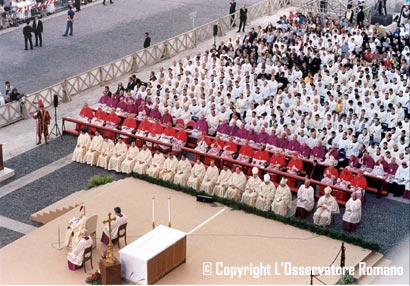
The procession consists of hundreds of clergy, seminarians, religious, members of confraternities and thousands of lay faithful. On the Vatican website, one gets an idea of the sheer scale of the occasion by looking at previous years' celebrations:
In Venezuela, however, they take a different approach - the Corriere della Sera informs us that the
symbolism here is the defeat of the evil devils by the Blessed Sacrament.
The liturgical highlight is the annual Corpus Christi Mass in the presence of the Holy Father at S.Giovanni in Laterano, followed by procession with the Blessed Sacrament to S.Maria Maggiore, where the evening is concluded with the Pope giving Benediction and the singing of the Salve Regina.
The procession consists of hundreds of clergy, seminarians, religious, members of confraternities and thousands of lay faithful. On the Vatican website, one gets an idea of the sheer scale of the occasion by looking at previous years' celebrations:
2003
2002
2001
In Venezuela, however, they take a different approach - the Corriere della Sera informs us that the
symbolism here is the defeat of the evil devils by the Blessed Sacrament.
Numbers Stations...
A few years ago, a friend of mine had an interest in shortwave radios and as well as the guilty pleasure of eavesdropping on the local law-enforcement agencies, I was also much amused to discover the existance of so-called 'number stations'. On these stations one could listen to mechanical-sounding voices reciting numbers interminably. My friend explained that these were secret coded transmissions to spies, though I took this explanation with a grain of salt.
Needless to say, activities of this sort attract attention on the internet and this page by Simon Mason gives a good introduction.
Also, if you scroll down to the bottom of this page you'll see that there are recordings of various number stations for you to listen to.
Amongst my favorites are:
The Lincolnshire Poacher, seemingly operated by the British Royal Air Force. It is so-called after the cheery ditty used as a call-sign
The Stasi Gong Station
Sweedish Rhapsody, a Polish broadcast with a music-box intro
Papa November, a West German broadcast
This page of miscellananeous stations, including a Spanish broadcast using 'Don't Cry for me Argentina' as a call sign.
On a slightly related note, it used to be the practice of the Secretariat of State to broadcast messages to its Nunciatures on the Vatican Radio frequencies.
Needless to say, activities of this sort attract attention on the internet and this page by Simon Mason gives a good introduction.
Also, if you scroll down to the bottom of this page you'll see that there are recordings of various number stations for you to listen to.
Amongst my favorites are:
The Lincolnshire Poacher, seemingly operated by the British Royal Air Force. It is so-called after the cheery ditty used as a call-sign
The Stasi Gong Station
Sweedish Rhapsody, a Polish broadcast with a music-box intro
Papa November, a West German broadcast
This page of miscellananeous stations, including a Spanish broadcast using 'Don't Cry for me Argentina' as a call sign.
On a slightly related note, it used to be the practice of the Secretariat of State to broadcast messages to its Nunciatures on the Vatican Radio frequencies.
Wednesday, June 09, 2004
Pretenders and the Princes in the Tower
Not having anything particularly original to say, I have chosen to take my inspiration from Matt of the Holy Whapping's post on Louis XVII of France and the various pretenders who attempted to assume his identity.
The death of France's boy-king brings to mind the mysterious vanishing of Edward V of England and his brother Richard Duke of York. Following the death of their father Edward IV in 1483, control of the kingdom passed to the Protector Richard Duke of Gloucester. They were accomodated in the Tower of London whilst preparations were made for the coronation of of the 12 year-old monarch when questions arose as to the legitimacy of the children. Richard of Gloucester then arranged for himself to be crowned Richard III of England and the 'Princes in the Tower'. A couple of years later, Richard III was toppled from his throne and replaced by Henry VII, a Tudor with a very shaky claim to the kingdom. Thanks to Shakespeare's Richard III and St. Thomas More's history, the most commonly accepted version of events puts the blame for the murder squarely on the 'deformed' shoulders of Richard III, but the evidence is ambiguous. Various other theories have been proposed, such as the princes dying of natural causes, partisans of Richard III killing the princes without his knowledge or (very plausibly given what we know of the Tudors) their being murdered by Henry VII who say them as a threat to his throne and found blaming Richard very convenient for the purposes of propaganda. There are any number of websites out there dealing with the Princes, but of particular interest are those written by Ricardians who try to rehabilitate the last king of the house of York. (Particularly fun, if you're ever in York, is the dramatic apology for Richard put forward by local actor Michael S. Bennett)
What is without a doubt, however, is that well into the reign of Henry VII (1485-1509) there remained a huge doubt regarding the fate of the princes (there were tales of them living in Europe) and two pretenders to the English crown attempted to urge their claim on the basis of being one of the princes. Both Lambert Simnel and Perkin Warbeck both claimed to be Richard, Duke of York, younger brother to Edward V. There are several other similarities in their escapades - both emerged from obscurity and common birth, both suceeded in raising support in Ireland and both lead abortive rebellions against Henry VII.
Simnel was schooled by an Oxford priest in courtly manners, and after a period of claiming to be Richard, Duke of York, changed his story and as Edward, Earl of Warwick (nephew to Edward IV, first cousin of the princes in the tower and potential claimant to the throne) began his campaign for the English throne in Dublin. There, in 1487, at the age of 10, he was crowned Edward VI of England. The Irish, having Yorkist sympathies and always keen to cause trouble for an English king, backed Simnel militarily and also managed to secure some support from Europe, including a force of Flemish soldiers. Henry VII, unbeknownst to his enemies, actually had the real Edward of Warwick in prison and paraded him through the steets of London to demonstate Simnel's imposture. The Irish and Flemish force were quickly defeated after landing in England. Seeing that Simnel was merely the tool of older conspirators, Henry VII gave him a position in the royal kitchens, and he rose to become Royal Falconer before his death at the age of about 57.
Perkin Warbeck came from Flanders, and it seems that whilst in service to a merchant visiting Ireland something about his bearing attracted attention. Again, various Irish nobles of Norman descent, took him in hand. He moved in various court circles and by 1492 (aged about 18) he was summoned to Flanders to meet the sister of Edward IV (and thus aunt to the Princes) who gave him her support. Severa European monarchs also siezed the opportunity to discomfort Henry VII. Again, Warbeck seemed to have multiple personalities, being variously described as a bastard son of Richard III or a cousin of the princes, before it was finally decided that he was Richard, Duke of York. In 1495, aged about 21, he campaigned militarily in England and Ireland with little success, and so fled to Scotland. There, James IV arranged a marriage for him and he had some small military sucess in the North of England. Finally, in 1497, with a small force, he beagn his last campaign by landing at Lands End at the south-western tip of England. Unsurprisingly, the disgruntled Cornish folk who disagreed with Henry VII's taxation policy joined in the rebellion and he made progress through Cornwall and Devon until he reached the walled city of Exeter which was strongly Tudor. Unable to progress any further, he fled and eventually gave himself up. (In reward for their loyalty, the City Council of Exeter were granted a Cap of Maintenance and Ceremonial Sword by the grateful Henry VII. A number of years later, Exeter would become the stumbling block for the Cornishmen who formed the Catholic Prayerbook Rebellion.) Warbeck was imprisoned in the tower and in 1499 was dragged through the streets of London and hanged for attempting escape.
The death of France's boy-king brings to mind the mysterious vanishing of Edward V of England and his brother Richard Duke of York. Following the death of their father Edward IV in 1483, control of the kingdom passed to the Protector Richard Duke of Gloucester. They were accomodated in the Tower of London whilst preparations were made for the coronation of of the 12 year-old monarch when questions arose as to the legitimacy of the children. Richard of Gloucester then arranged for himself to be crowned Richard III of England and the 'Princes in the Tower'. A couple of years later, Richard III was toppled from his throne and replaced by Henry VII, a Tudor with a very shaky claim to the kingdom. Thanks to Shakespeare's Richard III and St. Thomas More's history, the most commonly accepted version of events puts the blame for the murder squarely on the 'deformed' shoulders of Richard III, but the evidence is ambiguous. Various other theories have been proposed, such as the princes dying of natural causes, partisans of Richard III killing the princes without his knowledge or (very plausibly given what we know of the Tudors) their being murdered by Henry VII who say them as a threat to his throne and found blaming Richard very convenient for the purposes of propaganda. There are any number of websites out there dealing with the Princes, but of particular interest are those written by Ricardians who try to rehabilitate the last king of the house of York. (Particularly fun, if you're ever in York, is the dramatic apology for Richard put forward by local actor Michael S. Bennett)
What is without a doubt, however, is that well into the reign of Henry VII (1485-1509) there remained a huge doubt regarding the fate of the princes (there were tales of them living in Europe) and two pretenders to the English crown attempted to urge their claim on the basis of being one of the princes. Both Lambert Simnel and Perkin Warbeck both claimed to be Richard, Duke of York, younger brother to Edward V. There are several other similarities in their escapades - both emerged from obscurity and common birth, both suceeded in raising support in Ireland and both lead abortive rebellions against Henry VII.
Simnel was schooled by an Oxford priest in courtly manners, and after a period of claiming to be Richard, Duke of York, changed his story and as Edward, Earl of Warwick (nephew to Edward IV, first cousin of the princes in the tower and potential claimant to the throne) began his campaign for the English throne in Dublin. There, in 1487, at the age of 10, he was crowned Edward VI of England. The Irish, having Yorkist sympathies and always keen to cause trouble for an English king, backed Simnel militarily and also managed to secure some support from Europe, including a force of Flemish soldiers. Henry VII, unbeknownst to his enemies, actually had the real Edward of Warwick in prison and paraded him through the steets of London to demonstate Simnel's imposture. The Irish and Flemish force were quickly defeated after landing in England. Seeing that Simnel was merely the tool of older conspirators, Henry VII gave him a position in the royal kitchens, and he rose to become Royal Falconer before his death at the age of about 57.
Perkin Warbeck came from Flanders, and it seems that whilst in service to a merchant visiting Ireland something about his bearing attracted attention. Again, various Irish nobles of Norman descent, took him in hand. He moved in various court circles and by 1492 (aged about 18) he was summoned to Flanders to meet the sister of Edward IV (and thus aunt to the Princes) who gave him her support. Severa European monarchs also siezed the opportunity to discomfort Henry VII. Again, Warbeck seemed to have multiple personalities, being variously described as a bastard son of Richard III or a cousin of the princes, before it was finally decided that he was Richard, Duke of York. In 1495, aged about 21, he campaigned militarily in England and Ireland with little success, and so fled to Scotland. There, James IV arranged a marriage for him and he had some small military sucess in the North of England. Finally, in 1497, with a small force, he beagn his last campaign by landing at Lands End at the south-western tip of England. Unsurprisingly, the disgruntled Cornish folk who disagreed with Henry VII's taxation policy joined in the rebellion and he made progress through Cornwall and Devon until he reached the walled city of Exeter which was strongly Tudor. Unable to progress any further, he fled and eventually gave himself up. (In reward for their loyalty, the City Council of Exeter were granted a Cap of Maintenance and Ceremonial Sword by the grateful Henry VII. A number of years later, Exeter would become the stumbling block for the Cornishmen who formed the Catholic Prayerbook Rebellion.) Warbeck was imprisoned in the tower and in 1499 was dragged through the streets of London and hanged for attempting escape.


Gibson Priest at Louis XVII Funeral?
Looking at the picture of yesterday's funeral, I note the presence of a distinguished looking priest in surplice and white stole to the left of the crown.
Could someone better-informed than myself confirm whether this might be the celebrated Fr Charles-Roux (.pdf document), who also happens to be a vice-president of the Royal Stuart Society. (It's a shame Matt of the Holy Whapping never stumbled upon him in Rome...)
Could someone better-informed than myself confirm whether this might be the celebrated Fr Charles-Roux (.pdf document), who also happens to be a vice-president of the Royal Stuart Society. (It's a shame Matt of the Holy Whapping never stumbled upon him in Rome...)
Tuesday, June 08, 2004
Satanism in Italy...
As this disturbing article in the English pages of Corriere della Sera illustrates, Satanism is quite a problem in certain parts of Italy. Accounts of Satanic rituals and murders like the ones described in the article are much more common in Italian newspapers than in the English-speaking world. The books of Fr Gabriele Amorth also testify to the fact that there's something decidedly evil at work in ceratin parts of Italy.
The article above mentions the North of Italy as being home to these cults - this agrees with what I have heard on an anecdotal level. I am also aware of certain places in the Castelli Romani with a bad reputation and note that in the churches of some Italian dioceses there are prominent notices warning of excommunication for those who steal the Blessed Sacrament and the Sacrament itself is reserved in a side-chapel protected by heavy-duty wrought-iron gates.
The article above mentions the North of Italy as being home to these cults - this agrees with what I have heard on an anecdotal level. I am also aware of certain places in the Castelli Romani with a bad reputation and note that in the churches of some Italian dioceses there are prominent notices warning of excommunication for those who steal the Blessed Sacrament and the Sacrament itself is reserved in a side-chapel protected by heavy-duty wrought-iron gates.
Monday, June 07, 2004
Latin with Fr. Foster
Fr Gary Coulter presents this page dedicated to Fr Reggie Foster OCD, one of the Church's top Latinists.
Also, scroll down through the Vatican Radio Audio Archive to hear an episode of his 'Latin Lover' radio program.
Also worth a listen are Fr Philip Whitmore's program on hymns and Gill Bevilacqua's Sunday Gospel reflection.
Also, scroll down through the Vatican Radio Audio Archive to hear an episode of his 'Latin Lover' radio program.
Also worth a listen are Fr Philip Whitmore's program on hymns and Gill Bevilacqua's Sunday Gospel reflection.
Sunday, June 06, 2004
Norwegian, erm, Lithuanian Wood?
Matt, over at the Shrine of the Holy Whapping, 'blogs about the Wooden Churches of Lituania. Not to be outdone, I tried to find a picture of Rearcross Church, a chapel constructed from corrugated iron which I stumbled upon in rural Ireland some years ago. I couldn't find a picture, but did discover that it contains stained glass representations of SS. William and Thomas Aquinas, presumably after the names of the donors. I also seem to remember that the church was formerly a protestant chapel in a mining part of Wales, and was purchased by this Irish parish when the coal industry in that part of Wales went into decline and the chapel no longer had a congregation.
It claims to be unique, but it seems that there is a Swiss Gothic corrugated iron church, which was/is used by a Church of Ireland (Anglican) parish in Co. Monaghan.
The story of how Rearcross got its chapel reminds me of another story about the opportunistic capabilities of the Irish Clergy in matters of money - have a look at the distinctive copper dome of Our Lady Refuge of Sinners, one of Dublin's finest churches. The dome was originally constructed in Scotland for a Russian Orthodox Church, but the Bolshevik Revolution made that project impossible. Therefore, when rebuilding the church after the fire, the canny priests from Dublin were able to acquire this unusual feature for a knockdown price.
It claims to be unique, but it seems that there is a Swiss Gothic corrugated iron church, which was/is used by a Church of Ireland (Anglican) parish in Co. Monaghan.
The story of how Rearcross got its chapel reminds me of another story about the opportunistic capabilities of the Irish Clergy in matters of money - have a look at the distinctive copper dome of Our Lady Refuge of Sinners, one of Dublin's finest churches. The dome was originally constructed in Scotland for a Russian Orthodox Church, but the Bolshevik Revolution made that project impossible. Therefore, when rebuilding the church after the fire, the canny priests from Dublin were able to acquire this unusual feature for a knockdown price.
Trinity Sunday...
It has been said that the Church in her wisdom instituted Trinity Sunday so that at least once a year there's some theology in the homily...
Anyway, if you don't hear the following at Mass today, you might want to see about getting a new choir director!
Incidentally, I'd also urge you never to pass up on a performance of Elgar's oratorio 'The Dream of Gerontius' - his masterful arrangement of Newman's poem is probably the most beautiful meditation on the church's teaching on what awaits us at the end of this mortal life. The 'Dream' was almost certainly the last musical performance attended by Pius XII (of happy memory) before he died. Sir John Barbirolli conducted a performance at Castel Gandolfo a few days before the Pontiff's death. His Holiness is said to have described it as a 'sublime masterpiece'.
Anyway, if you don't hear the following at Mass today, you might want to see about getting a new choir director!
Firmly I believe and truly
God is Three, and God is One;
And I next acknowledge duly
Manhood taken by the Son.
And I trust and hope most fully
In that Manhood crucified;
And each thought and deed unruly
Do to death, as He has died.
Simply to His grace and wholly
Light and life and strength belong,
And I love supremely, solely,
Him the holy, Him the strong.
And I hold in veneration,
For the love of Him alone,
Holy Church as His creation,
And her teachings are His own.
And I take with joy whatever
Now besets me, pain or fear,
And with a strong will I sever
All the ties which bind me here.
Adoration aye be given,
With and through the angelic host,
To the God of earth and heaven,
Father, Son and Holy Ghost.
- John Henry Newman (From The Dream of Gerontius)
Incidentally, I'd also urge you never to pass up on a performance of Elgar's oratorio 'The Dream of Gerontius' - his masterful arrangement of Newman's poem is probably the most beautiful meditation on the church's teaching on what awaits us at the end of this mortal life. The 'Dream' was almost certainly the last musical performance attended by Pius XII (of happy memory) before he died. Sir John Barbirolli conducted a performance at Castel Gandolfo a few days before the Pontiff's death. His Holiness is said to have described it as a 'sublime masterpiece'.
Unborn Child Kidnapped
Disturbing news from Columbia where an unborn child was literally stolen from his mother's womb. Thankfully, news reports seem to indicate that mother and child are now safe.
Curious Goings-on at the Brompton Oratory
At some stage over the summer I hope to be in London, and whilst there I will undoubtedly call on the beautiful Brompton Oratory, a church notable for its history and liturgy. Whilst browsing through Robin Cross's book 'Curious London' I discovered that it had another claim to fame:
Near to the Oratory, stands the CoE church of Holy Trinity, Brompton. Apparently, a statue of St. Francis of Assisi in the church grounds was used to indicate another KGB dead letter box.
There could be few more respectable locations than Brompton Oratory in Knightsbridge, but this splendid Catholic Church on the Brompton Road was the site chosen by the KGB as one of their safest dead letter boxes in London. It was here that documents or microfilm were left by one agent to be picked up by another.Before we get carried away by the idea of the good fathers of the Oratory storing secret plans under their birettas, I'd better explain that the 'dead letter box' was in fact a little space behind a pillar next to a copy of the Pietà, just inside the door of the church. According to Cross, this information was almost immediately intercepted by British Intelligence in 1985. (What, an oxymoron?)
Near to the Oratory, stands the CoE church of Holy Trinity, Brompton. Apparently, a statue of St. Francis of Assisi in the church grounds was used to indicate another KGB dead letter box.
Friday, June 04, 2004
Dear Jesus and Mary...
An interesting note courtesy of Found Magazine. One wonders what reply it'll receive.
More on the Surplice Riots...
Thanks to Quenta Nârwenion who brought to my attention the fact that Ven. Newman commented (I almost wrote blogged! Would Newman have blogged?) on the Surplice Riots in his Difficulties of Anglicans.
I shan't apologise for the lengthy quotation - this is the satirical side of Newman so little appreciated today.
When clergymen of Latitudinarian theology were promoted to dignities, did the faithful of the diocese, or of the episcopal city, rise in insurrection? Did parishioners blockade a church's doors to keep out a new incumbent, who refused to read the Athanasian Creed? Did vestries feel an instinctive reverence for the altar-table, as soon as that reverence was preached? Did the organs of public opinion pursue with their invectives those who became dissenters or Irvingites? Was it a subject of popular indignation, discussed and denounced in railway trains and omnibuses and steamboats, in clubs and shops, in episcopal charges and at visitation dinners, if a clergyman explained away the baptismal service, or professed his intention to leave out portions of it in ministration? Did it rouse the guards or the artillery to find that the Bishop, where they were stationed, was a Sabellian? Was it a subject for public meetings if a recognition was attempted of foreign Protestant ordinations? Did animosity to heretics of the day go so far as to lead speakers to ridicule their persons and their features, amid the cheers of sympathetic hearers? Did petitions load the tables of the Commons from the mothers of England or Young Men's Associations, because the Queen went to a Presbyterian service, or a high minister of state was an infidel? Did the Bishops cry out and stop their ears on hearing that one of their body denied original sin or the grace of ordination? Was there nothing in the course of the controversy to show what the nation thought of that controversy, and of the parties to it?
Yes, I hear a cry from an episcopal city; I have before my eyes one scene, and it is a sample and an earnest of many others. Once in a way, there were those among the authorities of the Establishment who made certain recommendations concerning the mode of conducting divine worship: simple these in themselves, and perfectly innocuous, but they looked like the breath, the shadow of the movement; they seemed an omen of something more to come; they were the symptoms of some sort of ecclesiastical favour bestowed in one quarter on its adherents. The newspapers, the organs of the political, mammon-loving community, of those vast multitudes of all ranks who are allowed by the Anglican Church to do nearly what they will for six, if not seven days in the week,—who, in spite of the theological controversies rolling over their heads, could, if they would, buy, and sell, and manufacture, and trade at their pleasure,—who might be unconcerned, and go their own way, for no one would interfere with them, and might "live and let live,"—the organs, I say, of these multitudes kindle with indignation, and menace, and revile, and denounce, because the Bishops in question suffer their clergy to deliver their sermons, as well as the prayers, in a surplice. It becomes a matter of popular interest. There are mobs in the street, houses are threatened, life is in danger, because only a gleam of Apostolical principles, in their faintest, wannest expression, is cast inside a building which is the home of the national religion. The very moment that Catholicism ventures out of books, and cloisters, and studies, towards the national house of prayer, when it lifts its hand or its very eyebrow towards this people so tolerant of heresy, at once the dull and earthly mass is on fire. It would be little or nothing though the minister baptized without water, though he chucked away the consecrated wine, though he denounced fasting, though he laughed at virginity, though he interchanged pulpits with a Wesleyan or a Baptist, though he defied his Bishop; he might be blamed, he might be disliked, he might be remonstrated with; but he would not touch the feelings of men; he would not inflame their minds;—but, bring home to them the very thought of Catholicism, hold up a surplice, and the religious building is as full of excitement and tumult as St. Victor's at Milan in the cause of orthodoxy, or St. Giles', Edinburgh, for the Kirk.
"The uproar commenced," says a contemporary account, "with a general coughing down; several persons then moved to the door making a great noise in their progress; a young woman went off in a fit of hysterics, uttering loud shrieks, whilst a mob outside besieged the doors of the building. A cry of 'fire' was raised, followed by an announcement that the church doors were closed, and a rush was made to burst them open. Some cried out, 'Turn him out,' 'Pull it off him.' In the galleries the uproar was at its height, whistling, cat-calls, hurrahing, and such cries as are heard in theatres, echoed throughout the edifice. The preacher still persisted to read his text, but was quite inaudible; and the row increased, some of the congregation waving their hats, standing on the seats, jumping over them, bawling, roaring, and gesticulating, like a mob at an election. The reverend gentleman, in the midst of the confusion, despatched a message to the mayor, requesting his assistance, when one of the congregation addressed the people, and also requested the preacher to remove the cause of the ill-feeling which had been excited. Then another addressed him in no measured terms, and insisted on his leaving the pulpit. At length the mayor, the superintendent of the police, several constables, also the chancellor and the archdeacon, arrived. The mayor enforced silence, and, after admonishing the people, requested the clergy-man to leave the pulpit for a few minutes, which he declined to do,—gave out his text, and proceeded with his discourse. The damage done to the interior of the church is said to be very considerable." I believe I am right in supposing that the surplice has vanished from that pulpit from that day forward. Here, at length, certainly are signs of life, but not the life of the Catholic Church.
I shan't apologise for the lengthy quotation - this is the satirical side of Newman so little appreciated today.
Roman Report...
Things are quiet here in Rome today, with the exception of the police helicopters flying overhead providing security for President Bush's visit. There's a strong police presence on the street, and many are staying away from the city centre to avoild being caught up in protests or police roadblocks. Today is also the anniversary of the liberation of Rome. (Some cynics suggest asking the Italians who was liberating who from whom?) In addition to European election posters, the city is plastered with a mixture of George Bush 'Wanted' posters and Forza Italia messages saying 'Welcome President Bush'. The excellent Giannelli presents these two cartoon commenting on Bush's mixed reception.
In today's paper we see Berlusconi urging Bush to 'keep looking right'. Yesteray's cartoon has the same protagonists, with Bush being warned, 'Watch out George! There aren't the Italians of 1944 any more, now there are the extremely dangerous pacifists!'
On a totally unrelated note, the Corriere della Sera also presents us with a picture of Louis XVII's heart in a glass urn. It is to be laid to rest with his body in the crypt of the church of Saint Denis.
Over at Pontifications, we have this excellent post about naming the Trinity Creator, Redeemer and Sanctifier. The whole issue of naming the persons of the Trinity is actually a fascinating area of Theology. Obviously, Father, Son and Holy Spirit are the privileged and proper names to use on the basis of scriptural authority, and there can be no excuse for abandoning these names for baptismal purposes. Pontificator's reasoning regarding why it's not correct to say 'Creator, Redeemer and Sanctifier' is:
This is fair enough, but isn't quite the full story. It is acceptable practise (within limits) due to the way in which God has acted in history to engage in appropriation of God's acts or qualities to one member of the Trinity or the other. Consequently, it is acceptable to refer to the Son as our Redeemer, even though we are well aware that any act of God is an act of all three persons.
However, this practise is not the same as properly 'naming' the Trinity, because it attributes properties in a manner which is reasonable, but not strictly correct. Furthermore, it views the Divine Persons as they 'appear' in relationship to us (i.e. from the point of view of the Economic Trinity) and not as they are 'in se', i.e. how they are with respect to each other in the Immanent Trinity. Consequently, the Father is Father with respect to the Son and the Son is Son with respect to the Father and the Father cannot be the Son and the Son cannot be the Father. However, the Holy Spirit causes difficulty here. I think it was St. Augustine that pointed out that the Holy Spirit's name is different - both the Father and the Son are Holy and both the Father and the Son are Spirit. Consequently, is the Holy Spirit the Third Person's 'proper' name? Well, there's no arguing with the baptismal formula given in the New Testament, but St. Augustine thought it helpful to refer to the Holy Spirit as 'Gift' and 'Love' as a proper (relational) titles within the Trinity, without suggesting any change to our normal Trinitaran formula.
I wonder if the fact that Holiness and Spiritual nature are shared by the Father and the Son casts any possible light on the Filioque controversy?
In today's paper we see Berlusconi urging Bush to 'keep looking right'. Yesteray's cartoon has the same protagonists, with Bush being warned, 'Watch out George! There aren't the Italians of 1944 any more, now there are the extremely dangerous pacifists!'
On a totally unrelated note, the Corriere della Sera also presents us with a picture of Louis XVII's heart in a glass urn. It is to be laid to rest with his body in the crypt of the church of Saint Denis.
Over at Pontifications, we have this excellent post about naming the Trinity Creator, Redeemer and Sanctifier. The whole issue of naming the persons of the Trinity is actually a fascinating area of Theology. Obviously, Father, Son and Holy Spirit are the privileged and proper names to use on the basis of scriptural authority, and there can be no excuse for abandoning these names for baptismal purposes. Pontificator's reasoning regarding why it's not correct to say 'Creator, Redeemer and Sanctifier' is:
All of the proposed substitutes for the Triune Name twist the apostolic faith. “Creator, Redeemer, Sanctifier,” for example, replaces the personal titles of the Triune Name with descriptions that are concurrently true for each Trinitarian person. In orthodox understanding, the Father creates/redeems/sanctifies by the Son through the Holy Spirit. “Creator, Redeemer, Sanctifier” is thus inherently modalistic.
This is fair enough, but isn't quite the full story. It is acceptable practise (within limits) due to the way in which God has acted in history to engage in appropriation of God's acts or qualities to one member of the Trinity or the other. Consequently, it is acceptable to refer to the Son as our Redeemer, even though we are well aware that any act of God is an act of all three persons.
However, this practise is not the same as properly 'naming' the Trinity, because it attributes properties in a manner which is reasonable, but not strictly correct. Furthermore, it views the Divine Persons as they 'appear' in relationship to us (i.e. from the point of view of the Economic Trinity) and not as they are 'in se', i.e. how they are with respect to each other in the Immanent Trinity. Consequently, the Father is Father with respect to the Son and the Son is Son with respect to the Father and the Father cannot be the Son and the Son cannot be the Father. However, the Holy Spirit causes difficulty here. I think it was St. Augustine that pointed out that the Holy Spirit's name is different - both the Father and the Son are Holy and both the Father and the Son are Spirit. Consequently, is the Holy Spirit the Third Person's 'proper' name? Well, there's no arguing with the baptismal formula given in the New Testament, but St. Augustine thought it helpful to refer to the Holy Spirit as 'Gift' and 'Love' as a proper (relational) titles within the Trinity, without suggesting any change to our normal Trinitaran formula.
I wonder if the fact that Holiness and Spiritual nature are shared by the Father and the Son casts any possible light on the Filioque controversy?
Thursday, June 03, 2004
The Casuist
Due to personal commitments 'blogging will be light over th next week or so, but I do have time to share a discovery I made in a somewhat ecelectic theological library.
The Old Oligarch's recent posts on theological manuals had me browsing in the Moral Theology section and I stumbled upon volumes 1,2,4 and 5 of 'The Casuist', a collection of cases in moral and pastoral theology, compiled by JA McHugh OP. Dating from the second decade of the 20th century, these volumes are full of 'cases' of the kind often found in preconciliar periodicals for clergy. This method of moral theology has fallen out of fashion, though American moral theologian Germain Grisez adopts this approach in the third volume of his 'The Way of the Lord Jesus' moral theology series.
An idea of the issues dealt with comes from perusing the index of volume 5 - there one finds such case-titles as 'Riding in Cars Without Paying a Fare', 'Unlawful Mass Intentions', 'A Marriage with Several Obstacles' and 'Apparitions of Poor Souls from Purgatory'.
Having flicked through some of the cases, amongst the most fascinating, and with the most ingenious solution is a real case regarding invalidity of ordination and the deal of confession. I set out herewith the case and will refrain from posting the solution for several days. Anyone so inclined may guess at the answer in the commment boxes.
The Old Oligarch's recent posts on theological manuals had me browsing in the Moral Theology section and I stumbled upon volumes 1,2,4 and 5 of 'The Casuist', a collection of cases in moral and pastoral theology, compiled by JA McHugh OP. Dating from the second decade of the 20th century, these volumes are full of 'cases' of the kind often found in preconciliar periodicals for clergy. This method of moral theology has fallen out of fashion, though American moral theologian Germain Grisez adopts this approach in the third volume of his 'The Way of the Lord Jesus' moral theology series.
An idea of the issues dealt with comes from perusing the index of volume 5 - there one finds such case-titles as 'Riding in Cars Without Paying a Fare', 'Unlawful Mass Intentions', 'A Marriage with Several Obstacles' and 'Apparitions of Poor Souls from Purgatory'.
Having flicked through some of the cases, amongst the most fascinating, and with the most ingenious solution is a real case regarding invalidity of ordination and the deal of confession. I set out herewith the case and will refrain from posting the solution for several days. Anyone so inclined may guess at the answer in the commment boxes.
Case.-The case here related has actually happened, though a long time ago. To Father Aurelius there came to confession a priest, whom we will call Ignotus. He mentioned a doubt about what seemed to him a substantial defect in the nature of his ordination, which Aurelius recognised as justified, and for this reason applied to the Sacred Penetentiary. Since an invalid ordination does not admit of sanation, as does marriage, the repetition of the ordination would be necessary. However, the Penitentiary esteemed the seal of confession so highly, and gave so much consideration to the name of the one (be it bona or mala fide) invalidly ordained, that it required no disclosure of the defect to a bishop, not even by the penitent himself. The whole matter of the confession, at least concerning the person of the priest, should remain perfectly unknown.
Wednesday, June 02, 2004
Before I retire...
Here's a page of medieval clothing, including several vestments. Note particularly the chasuble supposedly worn by St. Bernard of Clairveaux.
On surplices and the like...
This post over at the Shrine got me thinking about one of the books I most enjoy flicking through - the 1931 Vestments and Vesture - A Manual of Liturgical Art a translation of Dom EA Roulin OSB's Linges, Insignes et Vêtements Liturgiques. Both Dom Roulin and his translator Dom Justin McCann OSB were monks of the distinguished abbey of Ampleforth and the delightfully illustrated book reflects a certain French gallic pique when the author rails against unsuitable vesture combined albeit rendered in a very refined English Benedictine register.
The 308 page work is supplemented by 6 plates and 339 illustrations and covers such diverse topics as the evolution of the mitre, church linen, modern art and an intruiging chapter entitles 'Faults of Taste and their Cure'.
Dom Roulin was unmistakably a man with a mission - he spends pages arguing against what he perceives as unsuitable and decadent ornamentation. He's no liturgical minimalist such as we might encounter today, but nor does he have any enthusaism for the excesses of some. On page 13 he provides a picture of what he describes as 'A Typically Ugly Pall - The floral decoration and the monogram are embroidered in reddish thread. Observe the wretched effect of the crumpled lace.' He is also was also an enthusiast for the so-called Gothic chasuble. Chapter 8 is entitles Full Chasubles Lawful, Traditional and Beautiful' wherein he vindicates their legitrimate use and asserts that in Italy the 'gothic' chasuble was known as the 'Roman Chasuble' and what we would call 'Roman' (or fiddleback) was usually called the 'Italian Chasuble'.
Dom Roulin also provides some practical advice. On washing church linen he warns against modern detergents and urges:
Roulin also has strong views on surplices - basing himself on the regulations of St. Charles Borromeo he insists that the surplice be of linen, sparingly (if at all) ornamented with lace, having full sleeves and reaching to a point between knee and ankle. In short, he urges the use of what we would normally identify as an 'Anglican' surplice. To the best of my knowledge, this style of surplice is used in some diocese in the south of Italy, though it is rarely if ever seen in Rome.
Speaking of surplices, I am reminded of a certain historical incident I learned about when I had occasion to spend some time in the charming Cathedral city of Exeter. In 1844, the bishop and chapter decided the clergy of Exeter should wear the surplice whilst preaching, as was, I understand the liturgical law of the Church of England. However, to the populace this smacked of Popery, or at the very least Tractarianism and they reacted to this innovation with full-scale rioting. The decision was soon reversed, but as we read in this account trouble surfaced again in 1847.
Of interest to my readers might be this (alas undated) poster advertising a public meeting about 'Party Feeling' and this amusing .verse about the surplice riots.
The 308 page work is supplemented by 6 plates and 339 illustrations and covers such diverse topics as the evolution of the mitre, church linen, modern art and an intruiging chapter entitles 'Faults of Taste and their Cure'.
Dom Roulin was unmistakably a man with a mission - he spends pages arguing against what he perceives as unsuitable and decadent ornamentation. He's no liturgical minimalist such as we might encounter today, but nor does he have any enthusaism for the excesses of some. On page 13 he provides a picture of what he describes as 'A Typically Ugly Pall - The floral decoration and the monogram are embroidered in reddish thread. Observe the wretched effect of the crumpled lace.' He is also was also an enthusiast for the so-called Gothic chasuble. Chapter 8 is entitles Full Chasubles Lawful, Traditional and Beautiful' wherein he vindicates their legitrimate use and asserts that in Italy the 'gothic' chasuble was known as the 'Roman Chasuble' and what we would call 'Roman' (or fiddleback) was usually called the 'Italian Chasuble'.
Dom Roulin also provides some practical advice. On washing church linen he warns against modern detergents and urges:
Let us endeavour to be content with hot water and when poured on the linen let it meet there nothing but a layer of soda or a layer of ash. Some linen, as for instance the purificators, cannot be cleansed of its stains unless it is boiled in the water, with a little potash added. After that the work may be completed with soap, deft hands, rain water, and as much sun as possible; for the sun not content with drying will also whiten and purify. These simple instructions will suffice for the clerical readers to whom this book is addressed. We should trust the specialists in this matter, as for instance certain communities of nuns and certain devout persons, who acquit themselves of this task with a particular attention and love.
Roulin also has strong views on surplices - basing himself on the regulations of St. Charles Borromeo he insists that the surplice be of linen, sparingly (if at all) ornamented with lace, having full sleeves and reaching to a point between knee and ankle. In short, he urges the use of what we would normally identify as an 'Anglican' surplice. To the best of my knowledge, this style of surplice is used in some diocese in the south of Italy, though it is rarely if ever seen in Rome.
Speaking of surplices, I am reminded of a certain historical incident I learned about when I had occasion to spend some time in the charming Cathedral city of Exeter. In 1844, the bishop and chapter decided the clergy of Exeter should wear the surplice whilst preaching, as was, I understand the liturgical law of the Church of England. However, to the populace this smacked of Popery, or at the very least Tractarianism and they reacted to this innovation with full-scale rioting. The decision was soon reversed, but as we read in this account trouble surfaced again in 1847.
Of interest to my readers might be this (alas undated) poster advertising a public meeting about 'Party Feeling' and this amusing .verse about the surplice riots.
In brief...
Today is the 'Festa della Repubblica', the 58th anniversary of the foundation of the Republic. In Rome it's celebrated by military aircraft flyovers and a parade. According to the Corriere della Sera there are the inevitable counter-protests, with about 100 'Disobedience' protesters near the Coliseum and 'peace' campaigners hanging flags from the bridges over the Tiber. The 'Rainbow Flag' has become an incedibly popular symbol for peace here and the Romans seem totally oblivious to it connection to the 'Gay Rights' movement. Commenting on the number of rainbow flags hanging from the windows of appartments a priest I know said 'They say there are 5 million idiots in this country, well now we know where they all live!'.
Over at Basia Me, Catholica Sum Meredith provides an excellent review of Philip Pullman's Dark Material's trilogy. Pullman's books are certainly begin as an enjoyable read, but ultimately disappoint. Meredith puts her finger on exactly why this is so.
Regarding theological manuals, the debate is continued by Sodak Monk, with the Old Oligarch responding.
Over at Basia Me, Catholica Sum Meredith provides an excellent review of Philip Pullman's Dark Material's trilogy. Pullman's books are certainly begin as an enjoyable read, but ultimately disappoint. Meredith puts her finger on exactly why this is so.
Regarding theological manuals, the debate is continued by Sodak Monk, with the Old Oligarch responding.
Tuesday, June 01, 2004
De Theologia
There's an interesting post from the Old Oligarch regarding Theological Manuals.
Second hand book sales at monasteries and convents are great places to pick up old theological manuals, and that's where I remember acquiring my first manual quite a number of years ago. It was a manual of 'Pastoral Theology' and the problems it confronted seem light-years removed from those one might encounter today. It included pages and pages of hypothetical cases regarding what did and did not break the eucharistic fast. It is to the credit of the Catholic faithful of times past that they apparently took the eucharistic fast so seriously (you can be sure that's not the case today!) but when one comes across a discussion as regards whether someone who has swallowed paraffin after midnight might receive Holy Communion it's easy to appreciate the point of view that there was something which tended towards the pathological in some of the manual-based theology. I was also somewhat amused to discover that the sections dealing with the sins of the flesh were written in Latin. To this day I'm unsure whether the intention was to prevent scandal on behalf of a housekeeper who might flick through what 'Father' was reading or to blunt the effect of the passages for the priest himself.
The Oligarch also mentions the excellent 'Denzinger'. His version goes up to the 1950's, but the 38th edition of Denzinger Hunermann (taking one up to a dubium of 1995 on women's ordination) is availible in a 'bilingual' edition - Latin/Greek with facing Italian translation. The original edition has a German tranlsation and there is also a Spanish version. It's a matter of great puzzlement to me that there isn't an English language version. The nearest thing to it is the vastly inferior (though still worthwhile) Neuner and Dupuis 'The Christian Faith'. As well as containing fewer texts, Neuner and Dupuis also neglects to provide the original Greek or Latin texts, essential for anything beyond a superficial use of these texts.
Compared to speakers of Italian (and other European languages) we anglophones have been very poorly served with regards to theological resources of this kind. It wasn't until Norman Tanner's 1990 'Decrees of the Ecumenical Councils' that we've had a bilingual Latin/English version of the Vatican II texts. The two most common English language only editions, those of Flannery and of Abbott are both misleading and unclear in places without the original Latin text. Tanner's 2 volume work is based on Alberigo's critical edition of the conciliar decrees and covers all the Ecumenical Councils (not just Vatican II). This makes it quite expensive and it's quite difficult to get hold of. Nonetheless, despite shortcomings in the translation style of Tanner, the fact that the original texts are there more than makes up for any infelicities in translation, a science which is never exact anyway.
Second hand book sales at monasteries and convents are great places to pick up old theological manuals, and that's where I remember acquiring my first manual quite a number of years ago. It was a manual of 'Pastoral Theology' and the problems it confronted seem light-years removed from those one might encounter today. It included pages and pages of hypothetical cases regarding what did and did not break the eucharistic fast. It is to the credit of the Catholic faithful of times past that they apparently took the eucharistic fast so seriously (you can be sure that's not the case today!) but when one comes across a discussion as regards whether someone who has swallowed paraffin after midnight might receive Holy Communion it's easy to appreciate the point of view that there was something which tended towards the pathological in some of the manual-based theology. I was also somewhat amused to discover that the sections dealing with the sins of the flesh were written in Latin. To this day I'm unsure whether the intention was to prevent scandal on behalf of a housekeeper who might flick through what 'Father' was reading or to blunt the effect of the passages for the priest himself.
The Oligarch also mentions the excellent 'Denzinger'. His version goes up to the 1950's, but the 38th edition of Denzinger Hunermann (taking one up to a dubium of 1995 on women's ordination) is availible in a 'bilingual' edition - Latin/Greek with facing Italian translation. The original edition has a German tranlsation and there is also a Spanish version. It's a matter of great puzzlement to me that there isn't an English language version. The nearest thing to it is the vastly inferior (though still worthwhile) Neuner and Dupuis 'The Christian Faith'. As well as containing fewer texts, Neuner and Dupuis also neglects to provide the original Greek or Latin texts, essential for anything beyond a superficial use of these texts.
Compared to speakers of Italian (and other European languages) we anglophones have been very poorly served with regards to theological resources of this kind. It wasn't until Norman Tanner's 1990 'Decrees of the Ecumenical Councils' that we've had a bilingual Latin/English version of the Vatican II texts. The two most common English language only editions, those of Flannery and of Abbott are both misleading and unclear in places without the original Latin text. Tanner's 2 volume work is based on Alberigo's critical edition of the conciliar decrees and covers all the Ecumenical Councils (not just Vatican II). This makes it quite expensive and it's quite difficult to get hold of. Nonetheless, despite shortcomings in the translation style of Tanner, the fact that the original texts are there more than makes up for any infelicities in translation, a science which is never exact anyway.
De Philosophia
Today we celebrated the feast of St. Justin Martyr, patron saint of philosophers and one of my favourites. Born in Palestine c.100, his thirst for the truth led him through the philosophical schools of the time (Stoicism, Platonism, etc.) before finally converting to Christianity at about the age of thirty. He taught the faith in Asia Minor and in Rome, and his background enabled him to achieve a synthesis of faith and reason. He may therefore be described as the first theologian as we currently understand the word, not setting aside his philosophical knowledge, but instead using it to understand and defend the reasonableness and truth of the Christian faith. He composed two Apologias in which he sought to defend Christianity from the charges made by pagans and an imaginary 'Dialogue with the Jew Trypho'. It is thanks to St. Justin that we have the earliest description of the Sunday Eucharist, including virtually all the elements familiar to us from Mass today, including the collection!
St. Justin paid the ultimate price for his faith and the
Office of Readings for today describes his martyrdom.
St. Justin's approach regarding the relationships between faith and reason, theology and philosophy, has been pretty much that of mainstream Catholic theology since his time, Tertullian and his 'What has Athens to do with Jerusalem?' quip notwithstanding. It accords well with our Catholic understanding of the nature of the fall that we can humbly aim at a synthesis between faith and reason. Without reducing God to our level, we can argue for the reasonableness of the Christian faith. Personally, I would see it as being a case of our reason being able to apprehend the mysteries of God, whilst understanding that they are not to be comprehended. Philosophy allows us to develop a vocabulary and grammar to make our theological thinking rigorous and it also makes us more keenly aware of the problems and questions that God's revelation in Jesus Christ provides the ultimate answer to! Interestingly, there is also an opposite (if less significant) movement. Theology can inspire philosophical thought. The great medieval theologians were philosophers by default, whilst more recently Leibniz (though not a Catholic) was inspired by the doctrine of Transubstantiation to refine his metaphysical system. Not very approvingly, Nietzsche once wrote: 'Among Germans I am immediately understood when I say that philosophy has been corrupted by theologians’ blood. The Protestant parson is the grandfather of German philosophy'. One might also think of Kierkegaard and St. Edith Stein.
On a slightly related note, some of you might be interested by the following Imaginary Dialogue between St.Thérèse of Lisieux and Friedrich Nietzsche by a Rome based Jesuit Fr. Michael Paul Gallagher, an expert in the field of unbelief. (No, that's not an invitation for wisecracks about Jesuits and unbelief!)
Also worth a look is this piece (Microsoft Word Document) by distinguished Catholic philosopher and Thomist Prof Eleonore Stump of St. Louis University who recently gave a series of talks here in Rome.
St. Justin paid the ultimate price for his faith and the
Office of Readings for today describes his martyrdom.
The saints were seized and brought before the prefect of Rome, whose name was Rusticus. As they stood before the judgement seat, Rusticus the prefect said to Justin: “Above all, have faith in the gods and obey the emperors”. Justin said: “We cannot be accused or condemned for obeying the commands of our Saviour, Jesus Christ”.
Rusticus said: “What system of teaching do you profess?” Justin said: “I have tried to learn about every system, but I have accepted the true doctrines of the Christians, though these are not approved by those who are held fast by error”.
The prefect Rusticus said: “Are those doctrines approved by you, wretch that you are?” Justin said: “Yes, for I follow them with their correct teaching”.
The prefect Rusticus said: “What sort of teaching is that?” Justin said: “Worship the God of the Christians. We hold him to be from the beginning the one creator and maker of the whole creation, of things seen and things unseen. We worship also the Lord Jesus Christ, the Son of God. He was foretold by the prophets as the future herald of salvation for the human race and the teacher of distinguished disciples. For myself, since I am a human being, I consider that what I say is insignificant in comparison with his infinite godhead. I acknowledge the existence of a prophetic power, for the one I have just spoken of as the Son of God was the subject of prophecy. I know that the prophets were inspired from above when they spoke of his coming among men”.
Rusticus said: “You are a Christian, then?” Justin said: “Yes, I am a Christian”.
The prefect said to Justin: “You are called a learned man and think that you know what is true teaching. Listen: if you were scourged and beheaded, are you convinced that you would go up to heaven?” Justin said: “I hope that I shall God’s house if I suffer that way. For I know that God’s favour is stored up until the end of the whole world for all who have lived good lives”.
The prefect Rusticus said: “Do you have an idea that you will go up to heaven to receive some suitable rewards?” Justin said: “It is not an idea that I have; it is something I know well and hold to be most certain”.
The prefect Rusticus said: “Now let us come to the point at issue, which is necessary and urgent. Gather round then and with one accord offer sacrifice to the gods”. Justin said: “No one who is right thinking stoops from true worship to false worship”.
The prefect Rusticus said: “If you do not do as you are commanded you will be tortured without mercy”. Justin said: “We hope to suffer torment for the sake of our Lord Jesus Christ, and so be saved. For this will bring us salvation and confidence as we stand before the more terrible and universal judgement-seat of our Lord and Saviour”.
In the same way the other martyrs also said: “Do what you will. We are Christians; we do not offer sacrifice to idols”.
The prefect Rusticus pronounced sentence, saying: “Let those who have refused to sacrifice to the gods and to obey the command of the emperor be scourged and led away to suffer capital punishment according to the ruling of the laws”. Glorifying God, the holy martyrs went out to the accustomed place. They were beheaded, and so fulfilled their witness of martyrdom in confessing their faith in their Saviour.
St. Justin's approach regarding the relationships between faith and reason, theology and philosophy, has been pretty much that of mainstream Catholic theology since his time, Tertullian and his 'What has Athens to do with Jerusalem?' quip notwithstanding. It accords well with our Catholic understanding of the nature of the fall that we can humbly aim at a synthesis between faith and reason. Without reducing God to our level, we can argue for the reasonableness of the Christian faith. Personally, I would see it as being a case of our reason being able to apprehend the mysteries of God, whilst understanding that they are not to be comprehended. Philosophy allows us to develop a vocabulary and grammar to make our theological thinking rigorous and it also makes us more keenly aware of the problems and questions that God's revelation in Jesus Christ provides the ultimate answer to! Interestingly, there is also an opposite (if less significant) movement. Theology can inspire philosophical thought. The great medieval theologians were philosophers by default, whilst more recently Leibniz (though not a Catholic) was inspired by the doctrine of Transubstantiation to refine his metaphysical system. Not very approvingly, Nietzsche once wrote: 'Among Germans I am immediately understood when I say that philosophy has been corrupted by theologians’ blood. The Protestant parson is the grandfather of German philosophy'. One might also think of Kierkegaard and St. Edith Stein.
On a slightly related note, some of you might be interested by the following Imaginary Dialogue between St.Thérèse of Lisieux and Friedrich Nietzsche by a Rome based Jesuit Fr. Michael Paul Gallagher, an expert in the field of unbelief. (No, that's not an invitation for wisecracks about Jesuits and unbelief!)
Also worth a look is this piece (Microsoft Word Document) by distinguished Catholic philosopher and Thomist Prof Eleonore Stump of St. Louis University who recently gave a series of talks here in Rome.
Subscribe to:
Posts (Atom)